
AkzoNobel and Axalta Plan a Global Coatings Merger
AkzoNobel and Axalta proposed a $25 billion coatings combination. Its terms, financial backdrop and subsequent approval steps define the planned transaction.
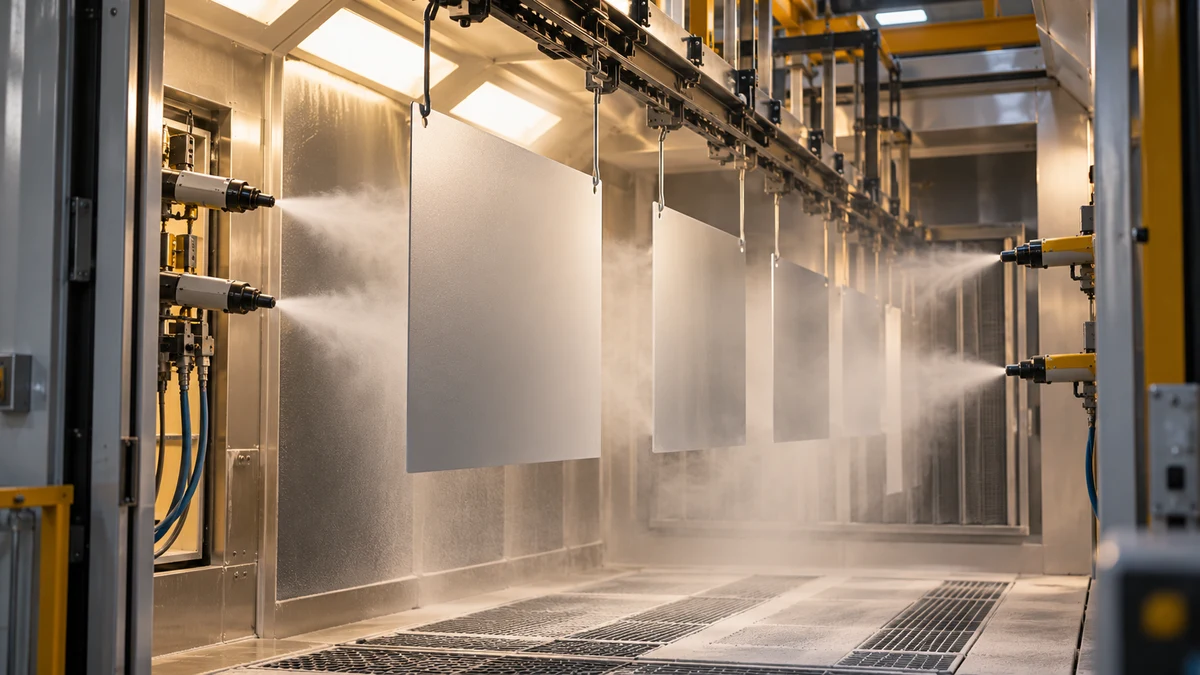
AkzoNobel and Axalta proposed an all-stock combination on November 18, 2025, with an enterprise value of approximately $25 billion for the resulting coatings group. AkzoNobel chief executive Greg Poux-Guillaume was chosen to lead the planned company, with headquarters in Amsterdam and Philadelphia. He presented cost reductions as a major source of value, rather than making the transaction dependent on a recovery in paint demand. Axalta would add a business concentrated on coatings and a strong presence in the United States. Poux-Guillaume expected the enlarged product portfolio to be more resilient during consumer downturns than decorative paints alone. The announcement initially produced uneven share-price reactions: by 1111 GMT, AkzoNobel shares were flat after an earlier decline of as much as 3.7%, while Axalta was down 2.5% after an initial 2.7% gain.
A broader industrial coatings portfolio
AkzoNobel and Axalta proposed bringing together decorative paints, powder coatings, automotive refinish, mobility, aerospace, marine, protective and industrial coatings. The companies identified 173 manufacturing locations and 91 research and development facilities, with approximately $400 million in combined annual research spending. Their financial illustration used approximately $17 billion in 2024 revenue, $3.3 billion in adjusted earnings before interest, tax, depreciation and amortisation, and $1.5 billion in pro forma adjusted free cash flow. The earnings figure included anticipated synergies, while adjusted free cash flow incorporated post-tax synergies and excluded identified items. These were not results earned by an already combined company. The calculation also preceded adjustments to align the companies' accounting standards and policies. Management targeted approximately $600 million in annual pre-tax cost synergies, mainly through procurement, administrative efficiencies, manufacturing-footprint changes and supply-chain management, with 90% expected within three years after closing. AkzoNobel shareholders would own 55% of the combined company and Axalta shareholders 45%.
The proposed share exchange and closing conditions
Axalta shareholders would receive 0.6539 AkzoNobel shares for each ordinary share held. AkzoNobel's special cash distribution was specified in euros: €2.5 billion, reduced by qualifying ordinary dividends with 2026 record dates before the special distribution. The closing conditions included:
- approval by shareholders of both companies;
- required regulatory clearances;
- securities registration and exchange-listing requirements;
- consultation with AkzoNobel's central works council;
- payment of the special distribution.
The original outside date was May 18, 2027, with an extension to November 18, 2027, in specified regulatory circumstances. Either company could become liable for a €150 million termination fee under defined conditions, including certain superior-proposal or board-recommendation events. The fee was not an automatic payment whenever completion failed.

The operating backdrop before the announcement
AkzoNobel combined an improved profit margin with declining reported revenue in its October 22, 2025, results. Third-quarter organic sales increased 1%, supported by price and product mix, while revenue fell 5% because of adverse currency translation. Adjusted EBITDA was €385 million, compared with €394 million a year earlier, including a €26 million adverse currency effect. The adjusted EBITDA margin nevertheless rose from 14.8% to 15.1%. Operating cash flow increased from €294 million to €331 million. Alongside its operating results, AkzoNobel recognised a €300 million provision concerning the Australian Ichthys project from 2013–15, including €275 million affecting operating income. Other claims remained contingent liabilities rather than provisions. The company disclosed insurance coverage of up to €500 million for relevant cash outflows, without establishing that all claims would be recovered. Those disclosures accompanied an outlook for approximately €1.48 billion in full-year adjusted EBITDA, subject to market uncertainty and exchange rates at the end of the quarter.
Axalta generated higher adjusted earnings from lower sales in the third quarter of 2025. On October 28, 2025, the company reported quarterly sales of $1.288 billion, down from $1.320 billion, while adjusted EBITDA increased from $291 million to $294 million. The adjusted margin reached 22.8%, against 22.1% a year earlier. Net income was $110 million. Within Performance Coatings, refinish sales fell 7% to $517 million and industrial sales declined 4% to $311 million. Mobility Coatings sales increased 4% to $460 million, generating $83 million of adjusted EBITDA and an 18.0% margin. Axalta had repurchased $100 million of shares during the quarter, taking nine-month purchases to $165 million. Its then-current capital-allocation plan envisaged spending up to another $250 million in the fourth quarter. That was a prospective repurchase programme, rather than money already returned to shareholders. Quarterly free cash flow was $89 million, compared with $164 million a year earlier.

An investor challenges the proposed combination
Artisan Partners' Global Value team opposed the transaction in a November 19, 2025, statement. Client accounts managed by the team held approximately 1.4 million Axalta shares, and the team managed about $35 billion in discretionary client assets. Daniel O'Keefe and Michael McKinnon led the group. Its objection centred on exchanging an interest in Axalta for shares in AkzoNobel at a valuation it considered inadequate. Artisan contrasted the merger announcement with Axalta management's recent confidence in its standalone earnings, prospects for refinish demand and intention to accelerate buybacks. It regarded those earlier statements as inconsistent with accepting the proposed share exchange. The investor also expressed interest in discussions with alternative buyers offering a price closer to its assessment of fair value. These were the views of an opposing shareholder, rather than an agreed valuation of either company. Artisan's statement did not establish that an alternative offer existed or that another transaction would follow.
Which businesses remained in the portfolio
AkzoNobel completed a separate disposal in India on December 10, 2025, selling Akzo Nobel India Limited to JSW Group. The divestment covered the Indian liquid paints and coatings business. The Indian powder-coatings operation and International Research Center remained wholly owned by AkzoNobel and continued within its global network. Those retained activities therefore differed from the businesses transferred to JSW. The transaction was based on a total enterprise value of approximately €1.4 billion and a stated enterprise-value-to-EBITDA multiple of 25 times. That enterprise value described the India transaction, rather than the consideration for the Axalta merger or cash received by each shareholder. The sale formed part of a strategic portfolio review announced in October 2024. Poux-Guillaume characterised the disposal as a step towards a sharper strategic focus, while JSW's leadership presented it as an opportunity to expand its position in the Indian paints market.

Standalone results after the merger proposal
AkzoNobel reported on February 3, 2026, that its full-year 2025 organic sales were flat as stronger price and mix offset lower volumes; reported revenue declined 5%. Adjusted EBITDA was €1.444 billion, with a margin of 14.2%, compared with 13.8% in 2024. Operating cash flow increased to €915 million from €673 million, and year-end net debt was twice adjusted EBITDA. Operating income reached €1.164 billion, including a positive €83 million balance of identified items incorporating the India disposal, Australian litigation provision and restructuring. Management's 2026 outlook remained a standalone projection, expressly excluding the proposed Axalta merger. It expected at least €1.47 billion in adjusted EBITDA using year-end 2025 exchange rates and adjusting for the India divestment. Poux-Guillaume did not anticipate a material recovery across end markets, describing a weak first half and easier comparisons later in the year. The release's figures were unaudited, and its adjusted measures supplemented the statutory financial information.
Axalta recorded full-year 2025 sales of $5.117 billion, down 3%, and net income of $379 million, compared with $391 million in 2024. Adjusted EBITDA reached $1.128 billion and its margin increased to 22.0%, from 21.2%. Operating cash flow was $649 million. Free cash flow of $466 million incorporated $196 million of capital expenditure and $13 million of interest proceeds on net-investment hedges; it was not simply operating cash less capital spending. Net debt stood at 2.3 times trailing adjusted EBITDA. The company released these preliminary figures on February 10, 2026. Axalta returned $165 million through share repurchases over the year and reduced gross debt by $230 million. The fourth quarter included a $204 million term-loan repayment. Cash and cash equivalents were $657 million at year-end, with total liquidity exceeding $1.4 billion. The figures were preliminary pending completion of financial closing procedures and the annual filing. They described Axalta's standalone year, without establishing that the proposed merger's synergy targets had been achieved.

The structure develops during 2026
The companies amended the agreement on May 27, 2026. Under the amended structure filed the following day, a second wholly owned Bermuda subsidiary would sit above the original merger subsidiary. Following the initial merger and related contributions, a second merger would place the surviving business directly beneath AkzoNobel. The filing attributed this change to optimising the companies' tax integration and stated that it did not change the transaction's tax consequences for Axalta shareholders. The amendment also provided alternatives for appointing jointly nominated independent directors: temporary replacement appointments effective at closing, followed by a shareholder meeting, or nomination at a subsequent AkzoNobel general meeting before completion. These were changes to the proposed structure and appointment arrangements. The remaining provisions of the original agreement stayed in force except where expressly modified. Signing the amendment did not itself complete either merger or remove the outstanding closing conditions.
Axalta shareholders approved the merger proposal at a special meeting on August 5, 2026. Of the 214,018,930 shares entitled to vote at the June 11 record date, 179,049,089 were represented at the meeting. The merger received 178,601,654 votes in favour, 55,032 against and 392,403 abstentions. The reported 99.97% approval rate referred to affirmative and negative votes, excluding abstentions and broker non-votes; support represented approximately 83.45% of all shares entitled to vote. Shareholders separately approved the bye-law proposal and a nonbinding advisory resolution concerning transaction-related executive compensation. A proposed adjournment resolution was unnecessary because sufficient votes had been secured, so it was not submitted. Shareholders voted on the agreement as amended on May 27 and July 23, 2026. Approval settled the Axalta shareholder vote, while completion still depended on the transaction's other requirements.

Proposed leadership and board membership
Stephan B. Tanda, Denise C. Johnson and Robert Schuchna agreed on August 31, 2026, to serve as additional non-executive directors. Their appointments remained subject to a further shareholder approval process and were intended to take effect upon completion. Johnson was a Caterpillar group president responsible for Resource Industries and also served on ABB's board. Schuchna was a partner at Cevian Capital and a supervisory-board member at AkzoNobel, with another board role at Rexel. Tanda was then AptarGroup's president and chief executive, with his retirement from that executive role announced for September 1. The proposed combined board also included Rakesh Sachdev as chair, Ben Noteboom as vice-chair, Poux-Guillaume as chief executive and Chris Villavarayan as deputy chief executive. Jaska de Bakker, Jan Bertsch, Wouter Kolk and Kevin Stein completed the eleven-person roster. The announcement described the intended board following the merger, rather than directors already governing a completed combined business.
Competition reviews follow separate national processes
The Australian Competition and Consumer Commission permitted the transaction to proceed in its July 21, 2026, phase-one determination. Its assessment identified overlap in vehicle-refinish and powder coatings in Australia. The regulator considered the resulting aggregation in vehicle-refinish market share to be low. For powder coatings, third parties had raised consolidation concerns, but the ACCC regarded Axalta as a relatively small competitor and expected only a very small increase in the merged company's share. It also expected the business to continue facing competition from other powder suppliers, together with large established and smaller suppliers in vehicle refinish. On the evidence before it, the commission concluded that the acquisition was unlikely substantially to lessen competition in any market. The determination concerned the Australian review and did not establish approval in every other jurisdiction. Commissioner Williams made the decision under delegated authority. It was one completed regulatory step within a transaction still subject to other closing requirements.

The UK Competition and Markets Authority process remained open after a formal inquiry began on September 16, 2026. The published timetable set November 11, 2026, as the deadline for a phase-one decision, while noting that limited circumstances could permit an extension. An earlier invitation to comment had run from April 16 to May 1. That preliminary consultation gathered initial views about the proposed transaction's possible effect on competition before the formal inquiry started. The two stages therefore had different dates and purposes. Closure of the comment period did not mean that the merger review had ended, and commencement of the inquiry was not a clearance decision. The CMA had set a future decision deadline and had not recorded a clearance conclusion or a completed closing on the case page.
The proposed holding structure retained a corporate seat and tax residence in the Netherlands, with AkzoNobel serving as the holding entity and a new identity planned for the combined business. Axalta was incorporated in Bermuda and headquartered in Philadelphia. Both companies were publicly listed with dispersed ownership and no single controlling shareholder. Their business descriptions covered consumer and industrial paints, vehicle refinish, and industrial liquid and powder coatings. AkzoNobel operated in more than 150 countries and Axalta in more than 140. The notifying parties submitted their intended corporate structure to the European Commission. The submission remained their responsibility and did not constitute a Commission approval. The envisaged move from dual Amsterdam and New York listings to a single New York Stock Exchange listing remained part of the proposed combination.




















Leave a comment