
Apatit’s Khibiny resource base: investment, mining and ore research
Apatit’s resource programme combines mine development, equipment investment and ore research, with dated milestones and longer-term capacity targets.
A resource programme in the Khibiny mountains
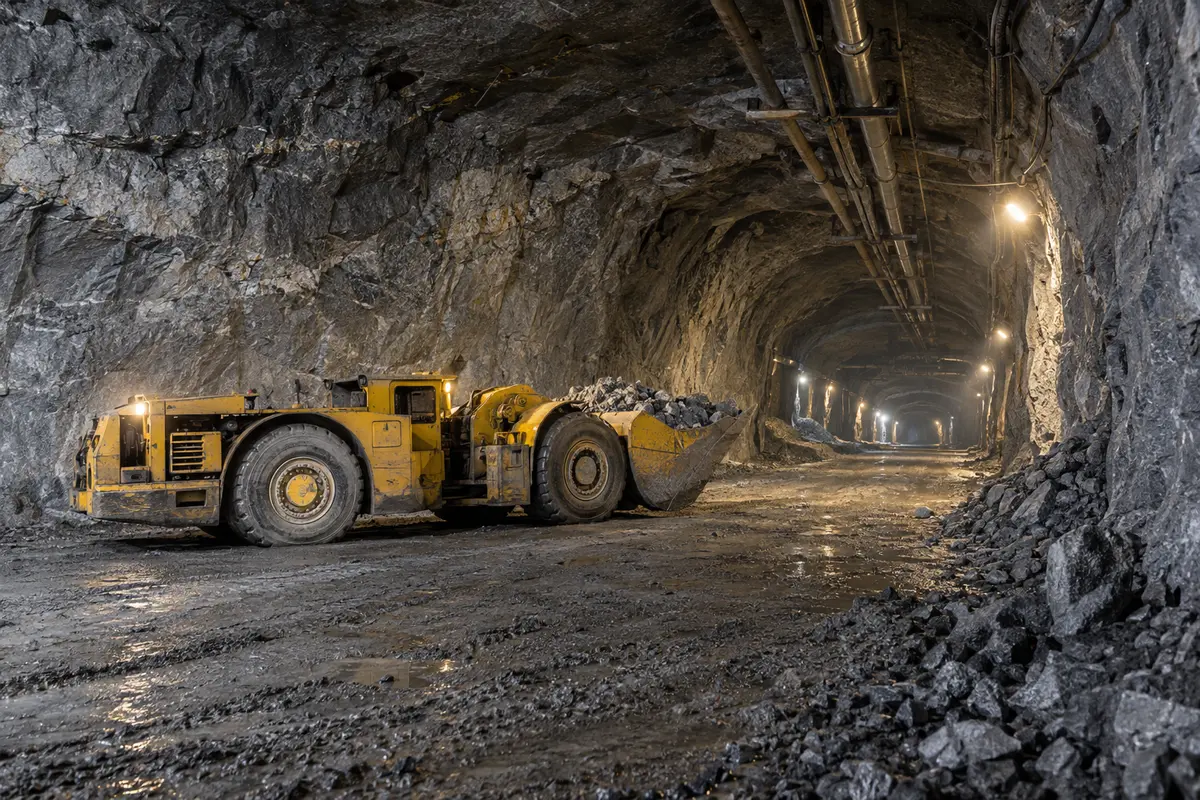
Apatit’s Kirovsk branch is preparing new mining areas within the Khibiny apatite-nepheline deposits of Murmansk region. On April 1, 2025, the proposed regional investment arrangements covered at least RUB 60 billion of capital spending, excluding VAT, during 2025–2027. The draft resolution envisaged a special investment contract running until December 31, 2033, strategic investment status for the project and an investment deduction of RUB 3 billion against corporate profit tax. Tax receipts from the company and its subsidiaries and affiliates were expected to reach at least RUB 27 billion during the three-year investment period. Employment commitments included both new jobs and preservation of existing positions. The mining programme encompassed the Vostochny open pits, the area beneath the Central pit and a new underground mine at the Rasvumchorr Plateau deposit. Diversion of the Loparskaya River was scheduled for completion in 2028, opening access to more than 100 million tonnes of ore. These were proposed commitments and project forecasts at the time of the April announcement.
The regional agreement and the signed contract
The earlier cooperation agreement between Murmansk region and Apatit was signed at the St. Petersburg International Economic Forum on June 6, 2024. Governor Andrey Chibis and PhosAgro chief executive Mikhail Rybnikov signed the document for a resource-base development programme involving at least RUB 160 billion through 2033. Apatit undertook to preserve the existing employment level at its regional enterprises. The regional government, in turn, agreed to consider support measures available under the legislation. That undertaking concerned possible state support rather than an unconditional payment of the investment sum from the regional budget. The agreement covered development of the Kirovsk branch’s ore resources over a longer period than the three-year spending commitment proposed the following April.

The special investment contract was subsequently signed in St. Petersburg on June 20, 2025. Chibis and Rybnikov again signed the document, this time establishing the contract for the strategic resource-base project. Apatit committed RUB 60 billion for 2025–2027, alongside new employment and preservation of workforce numbers. The investment programme included new ore-mining capacity, including replacement for capacity being retired, and the purchase and commissioning of equipment. Murmansk region undertook to provide investment-related benefits against profit tax paid into its budget by Apatit and its subsidiaries and affiliates. Chibis linked the support to the possibility of applying an investment tax deduction. Rybnikov placed the spending within a broader technical re-equipment programme extending to 2035. His expectation that the investment would sustain the mining complex’s position was a forward-looking assessment.
Ore, concentrate and the existing resource base
In Russia, the Kirovsk branch mined 40.7 million tonnes of apatite-nepheline ore in 2024, compared with 39.2 million tonnes in 2023. Open-pit operations accounted for 77.8% of the 2024 total. Its six deposits held combined balance reserves in categories A, B, C1 and C2 of 1,478,939 thousand tonnes on January 1, 2025, with average phosphorus pentoxide content of 14.02%. The deposits were Kukisvumchorr, Yukspor, Apatitovy Cirque, Rasvumchorr Plateau, Koashva and Njorkpahk. Their grades differed: Koashva averaged 17.32% phosphorus pentoxide, while Rasvumchorr Plateau averaged 12.06%. After processing, production comprised 11,391 thousand tonnes of phosphate rock and 1,133 thousand tonnes of nepheline concentrate, including syenite concentrate. Those concentrate volumes are separate from the larger amount of ore extracted. During 2024, construction at Rasvumchorr advanced on ventilation, drainage and communications. Preparations beneath the Saami pit included engineering documentation, hydraulic structures and an auxiliary access road. Excavation of the Yuksporiok–Gakman diversion tunnel was completed, while work continued on the Gakman–Loparskaya tunnel.

A new level at the Kirovsky mine
The Kirovsky mine’s +10 m level was commissioned in March 2024 after development that began in 2015. The project replaced depleted mining levels while providing access to additional ore. Its first commissioning stage entered testing in February 2022 on the Kukisvumchorr flank, combining crushing and delivery facilities with locomotive haulage. The Yukspor flank produced its first ore in October 2023. More than RUB 36 billion had been invested in the project by the March 2024 ceremony, and the associated reserves were approximately 300 million tonnes. Around 2,000 specialists and more than 50 contractors participated in construction. Underground transport included ballastless track and higher-capacity rolling stock, with crushing and delivery equipment serving the new workings. PhosAgro’s target for the new level was annual capacity of 9.4 million tonnes in 2028. That capacity target was distinct from output already achieved during testing and commissioning.
Separate investment schedules for separate mines
By June 2025, underground work was beginning in the Gakman section of the Yukspor deposit, following the earlier opening of the +10 m level. The Rasvumchorr Plateau mine remained a separate construction project, with capital investment expected to total approximately RUB 38 billion. Vostochny also had its own development schedule: PhosAgro planned more than RUB 33 billion of spending through 2035. Rybnikov included both projects within the company’s longer-term development strategy. These mine-specific estimates accompanied the June 2, 2025 announcement that shareholders had approved the 2024 annual report. They refer to different assets and project periods, rather than a single new mine with one combined construction budget.

Rasvumchorr moves into underground mining
Underground mining at the Rasvumchorr Plateau deposit began in October 2025, according to PhosAgro’s November 20 investment update. The new operation belonged to Apatit’s Kirovsk branch. Its design capacity was set at six million tonnes of apatite-nepheline ore annually, to be reached in 2034. The start of mining and the later capacity target were different milestones: the November announcement did not establish that the new mine was already producing six million tonnes a year. The board reviewed the project alongside other investment programmes across the group’s production sites.
During 2025, the Kirovsk branch increased ore production to 42.1 million tonnes, with open pits contributing 77.05%. Vostochny produced 9.7 million tonnes. The development programme targeted 12 million tonnes at the Koashvinsky open pit by 2030; Njorkpahk was scheduled to reach four million tonnes in 2026 before declining toward the end of open-pit extraction in 2031 and a subsequent underground transition. At Rasvumchorr, mining started at the +430 m level in the fourth quarter of 2025, alongside ventilation equipment, a transformer substation and the main drainage system. The CDU-6 crusher was scheduled for late 2029 and the full second phase for 2031. Water-diversion preparations included completion of the Gakman valley portal and the service incline’s surface breakthrough. A contractor was selected for Loparskaya valley works planned for summer 2026. The overall programme retained a 2028 completion and ore-start target for the Saami block-pillar project.

Beneficiation capacity and mineral composition
The mine programme was accompanied by a redesign of the ANOF-3 beneficiation plant. In May 2024, PhosAgro expected this work to increase annual apatite-concentrate capacity by almost 12%, to 10.5 million tonnes. This was a processing-capacity objective, expressed in concentrate rather than the tonnage of unprocessed ore mined. At the same time, construction continued at Rasvumchorr Plateau and underground extraction in the Gakman section was still scheduled for the end of 2024. The plant redesign and the mine-development announcements therefore concerned different stages of the production system, each with its own capacity measure and implementation schedule.
A research and development centre opened at the Russian Academy of Sciences’ Kola Research Centre in Apatity in March 2024, with approximately RUB 500 million of support from PhosAgro. The facilities included laboratories and testing equipment, following a cooperation agreement in 2020 and a three-party agreement involving the science ministry in June 2023. The planned research covered ore composition, preparation of ore for processing, mapping of reserves and flotation reagents. Its intended annual workload included at least 100 process samples and 2,500 samples for mineral-composition analysis. These were planned analytical volumes, rather than a tally of samples already completed at the opening. The programme linked the company’s mineral-resource work with the Kola centre’s scientific facilities. Mineral composition and the recovery of useful components were subjects for investigation; the opening of the centre did not itself establish a measured increase in industrial recovery or concentrate output.

Selectivity in the flotation laboratory
Galina Mitrofanova, Elena Chernousenko, Alena Kompanchenko and Aleksandr Kalugin investigated four reagent regimes for apatite-nepheline ore in research published online in December 2023 and in a 2024 journal issue. Their sample contained 17.27% apatite and 40.18% nepheline. Mineralogical examination distinguished coarse, liberated apatite from finer apatite trapped as inclusions within other minerals. Some inclusions were associated with nepheline, its alteration products and pyroxene. Increasing the phosphoric-acid ester component alongside tall-oil reagents improved concentrate quality in the experiments. Microscopy associated that improvement with fewer apatite intergrowths containing nepheline and pyroxene. A mixture of Phospholan PE-65 and Atrac-2600 could also improve quality, but showed substantially lower activity. The experiments compared reagent selectivity for a particular sample and mineral assemblage. Their findings concerned laboratory separation and concentrate composition, without establishing a corresponding increase in the Kirovsk plants’ annual production or a quantified saving across the mining complex.
Recovering nepheline from flotation tailings
A. V. Fomin’s study in the second 2024 issue of Obogashchenie Rud examined gravity separation of Khibiny apatite-flotation tailings. The laboratory work separated denser titanite, pyroxenes and amphiboles into a heavy fraction while concentrating nepheline in the lighter fraction. The separation was constrained by the small density difference between useful mineral and unwanted material. Feldspars and some other minerals had densities similar to nepheline or lower, making a high-grade product difficult to obtain through gravity methods alone. Proposed spiral-separation arrangements yielded preliminary concentrates containing 25.2–25.8% aluminium oxide, with recovery of 75.8–77.9%. Flotation was proposed as the finishing stage to obtain the required product grade. Fomin anticipated that the combination could improve the feed supplied to nepheline flotation and reduce flotation time. Those benefits were proposed consequences of the experimental process, rather than measured operating results from a newly commissioned commercial circuit.

Mineralogy inside a three-dimensional resource model
A. O. Kalashnikov, A. S. Ganyushkina, G. O. Nagovitsyn and N. G. Konopleva examined the Koashva deposit in research published in May 2026. Their element-to-mineral-properties conversion approach used MARSpline regression to connect chemical assays with mineral characteristics. Phosphorus, aluminium and titanium measurements formed the input, with different model combinations accommodating incomplete assay sets. The researchers constructed 108 regression models and rejected six that did not meet their statistical significance criterion. The resulting mineral estimates were incorporated into a three-dimensional block model, including conceptual criteria for identifying potentially refractory or lower-grade material. Validation included random training and validation splits, alternative splits for selected models and independent quantitative powder X-ray diffraction measurements. The model’s performance remained bounded by the compositional ranges and analytical methods represented in its training data. Application to other ore domains required independent validation. The work proposed support for planning and ore blending; it did not demonstrate an installed plant-control system or realised production savings.
Seismic monitoring underground
Alexander Gospodarikov, Ilia Revin and Konstantin Morozov studied seismic-event sequences at the Kukisvumchorr deposit in research published online in February 2023. Their analysis combined event timing, energy and spatial clustering, considering geological structures alongside changes associated with mining. The retrospective case used observations from 2020. Two estimated event dates preceded actual rockbursts by one to two days; a third required additional analysis and an amended forecast. Performance varied strongly with the prediction horizon. For the medium-term assessment, the researchers reported one false event per rockburst and no missed events. Short- and long-term assessments produced two to three false events per rockburst and missed all events under the stated evaluation. The different results place limits on interpreting the exercise as a general forecasting capability. The study examined a historical mine dataset and specified forecasting approaches, rather than demonstrating that a universal operational warning system had eliminated rockburst risk.

Water research elsewhere in the Khibiny massif
Regional groundwater research provides a separate case involving Oleniy Ruchey, operated by North-West Phosphorous Company rather than Apatit. Vladimir Dauvalter, Margarita Dauvalter and Zakhar Slukovskii examined observations from 2009–2023 in a study published online in September 2025. Four wells covered the quarry area, tailings facilities and water intake, with chemical sampling four times annually and water levels measured weekly. The researchers identified changes in mineralisation and major-ion composition associated with mineral leaching, nitrogen-containing explosives and changing groundwater levels. Seasonal peaks occurred in spring and autumn; lower water levels allowed more mineralised mine water to move toward wells, while rising levels brought infiltration from precipitation. Their findings related to the Oleniy Ruchey monitoring locations. They were not measurements of Apatit’s Loparskaya diversion project. The researchers called for further monitoring both within the mine’s influence zone and farther away to establish the extent and development of groundwater changes.
- Investment period: 2025–2027.
- Commitments: new mining capacity, equipment and employment.
- Regional support: investment-related profit-tax benefits.




















Leave a comment