
Carrier’s Viessmann acquisition and the reshaping of its portfolio
Carrier acquired Viessmann Climate Solutions as commercial HVAC demand grew. Financing, four business exits and later results trace the company’s portfolio transition.
Commercial demand meets a larger heating business
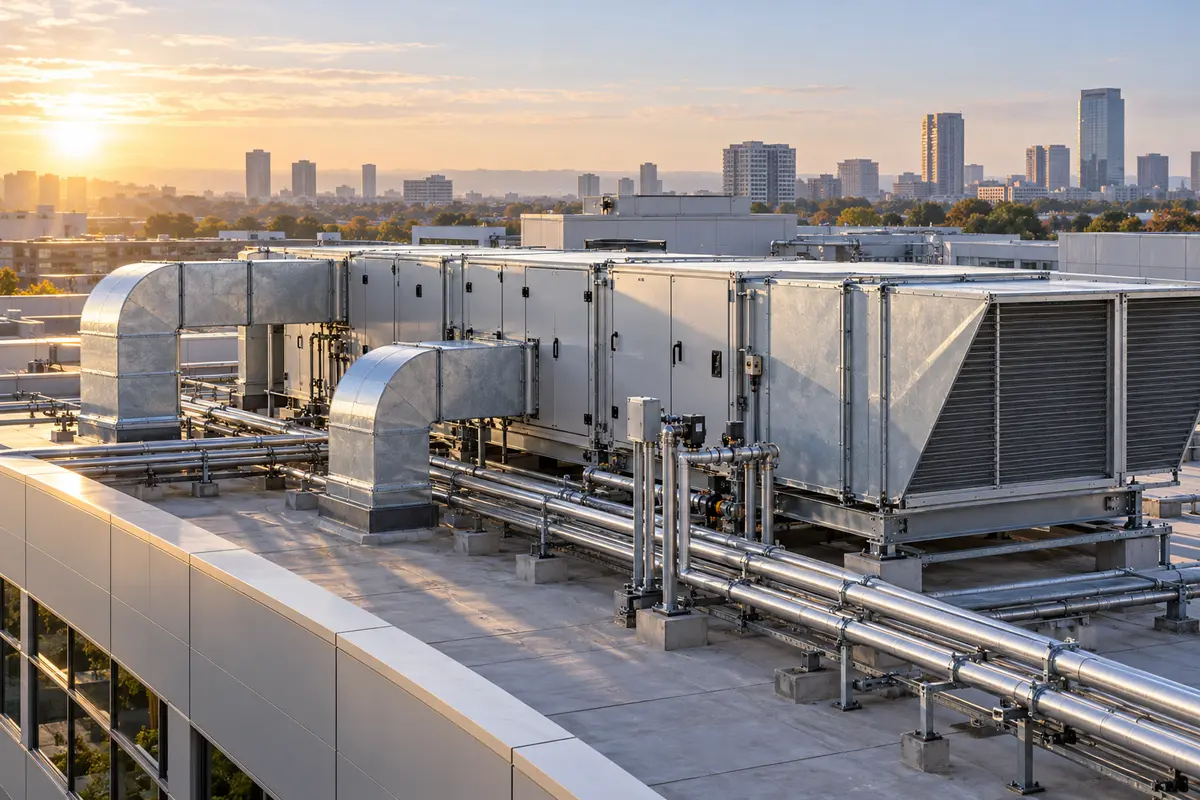
Carrier Global entered 2024 with commercial heating, ventilation and air-conditioning demand supporting its existing operations and a newly acquired European heating business expanding its portfolio. On 6 February 2024, Carrier beat Wall Street’s quarterly profit expectations as commercial customers and aftermarket activity supported demand. Commercial HVAC sales increased by a high-single-digit percentage globally. North American residential demand was weaker, while distributors reduced inventories. The different conditions affected customer markets within the same company rather than representing a uniform increase across all heating and cooling equipment.
Carrier initially forecast 2024 revenue of $26.50 billion, against analysts’ expectations of $24.55 billion. Its projected adjusted earnings per share ranged from $2.80 to $2.90, compared with an analyst estimate of $2.86. Refrigeration organic sales rose 6%, supported by transport refrigeration. The Viessmann Climate Solutions acquisition had closed in January, following an agreement valued at approximately $13.17 billion when announced.
The acquisition agreement and installer network
Carrier agreed on 25 April 2023 to acquire Viessmann Climate Solutions for €12 billion, subject to working-capital and other adjustments. The announced payment structure comprised 80% cash and 20% Carrier common stock issued to the Viessmann family. Its product and service portfolio extended beyond individual heat pumps to accessories, solar photovoltaic equipment, batteries and services. Together, those activities represented approximately 70% of its business at the time of the agreement; that percentage did not refer to heat pumps alone.
The acquired operation’s distribution and service relationships included more than 75,000 installers across 25 countries, over 1,300 service and support personnel, and more than 90,000 maintenance contracts. Carrier projected €200 million in annual cost synergies, principally from procurement and insourcing, with the vast majority expected by the third year. The company also expected the acquisition to be modestly dilutive to adjusted earnings per share in 2024 and accretive in 2025.

Closing terms, leadership and the Viessmann name
Carrier completed the acquisition on 2 January 2024. The closing consideration comprised €10.2 billion in cash and 58,608,959 Carrier common shares. Its acquisition announcement welcomed approximately 12,000 Climate Solutions employees. Thomas Heim took responsibility for Carrier’s residential and light-commercial HVAC business in Europe, the Middle East and Africa, including Viessmann Climate Solutions and Riello. Maximilian Viessmann joined Carrier’s board immediately and became a member of its Technology and Innovation Committee.
The seller obtained a right to nominate one Carrier director for ten years after closing, conditional on retaining at least half of the shares received, together with permitted transferees. Carrier also obtained an exclusive worldwide license to use the Viessmann trademarks in connection with the acquired business. The license required an annual €12 million royalty for its first five years, followed by royalties linked to licensed-product net sales. Transitional service arrangements provided for services between buyer and seller during separation, with agreed charges generally based on costs and expenses, including reasonably allocated overhead.
Two currencies and six financing tranches
Carrier completed private note offerings in November 2023 to help finance the acquisition. The dollar financing comprised three $1 billion tranches: 5.800% notes due in 2025, 5.900% notes due in 2034 and 6.200% notes due in 2054. The euro financing comprised €750 million of 4.375% notes due in 2025, €750 million of 4.125% notes due in 2028 and €850 million of 4.500% notes due in 2032. The totals were $3 billion and €2.35 billion, respectively, with different currencies, coupons and maturities.
Interest began accruing on the euro notes on 29 November 2023 and on the dollar notes the following day. Carrier intended to combine the proceeds with cash and borrowing under existing term-loan and bridge facilities to fund the cash consideration and transaction expenses. Chief Financial Officer Patrick Goris put the offerings’ weighted average debt cost at approximately 5.07%, including the effects of interest-rate locks. He put the weighted average cost of Carrier’s outstanding long-term debt below 4%. The notes also carried mandatory-redemption provisions if the acquisition failed to close by 25 October 2024.

A weaker international heat-pump market in 2023
Global heat-pump sales fell 3% in 2023 after two years of double-digit growth. The International Energy Agency associated the slowdown with higher interest rates, inflation and consumers’ reluctance to make large purchases. Natural-gas prices had also declined from their 2022 peaks. The agency’s market coverage included heat pumps supplying space heating or domestic hot water to homes and other buildings. Reversible air conditioners counted when used as primary heating equipment; equipment used only for cooling or as a supplement to another heating system was excluded.
The national markets moved differently. Heat-pump sales declined 15% in the United States, while gas-heating equipment sales fell 20%, allowing heat pumps to increase their market share despite fewer sales. China’s heat-pump sales grew 12%, whereas Japan’s fell 10%. European Union sales declined 5%. Germany recorded a 50% increase, although the IEA noted that fossil-fuel heating equipment sales also rose sharply there. In France, heat-pump sales stagnated but exceeded sales of fossil-fuel systems by nearly 60%.
First-quarter growth and the acquired business
Carrier’s first-quarter 2024 sales reached $6.2 billion, increasing 17% year on year. Organic growth was 2%, while the Viessmann acquisition contributed approximately 16% and divestitures reduced sales by about 1%. Americas commercial and light-commercial HVAC sales rose approximately 20%; residential sales declined by a low-single-digit percentage. In Europe, the Middle East and Africa, organic HVAC sales fell 10%. Commercial growth of about 10% was offset by weakness in residential and light-commercial equipment. Viessmann Climate Solutions sales declined 12%, with lower solar photovoltaic sales accounting for more than half the decrease.

GAAP operating profit fell 10% to approximately $500 million, including acquisition-related costs and acquired-intangible amortization. Adjusted, non-GAAP operating profit increased 44% to $927 million. Net income was $269 million, compared with adjusted net income of $565 million. Cash generated from operations of $40 million was less than capital expenditure of $104 million, producing a $64 million free-cash-flow outflow. Carrier’s April revenue forecast was approximately $26 billion, while its adjusted earnings-per-share forecast remained $2.80–$2.90.
Honeywell acquires the access-solutions operation
Honeywell completed its $4.95 billion acquisition of Carrier’s Global Access Solutions business in June 2024. The operation brought approximately 1,200 employees into Honeywell and combined three distinct access-control brands. LenelS2 supplied commercial and enterprise access systems. Onity supplied electronic locking technology, including hospitality applications and mobile credentials. Supra supplied cloud-based electronic lockboxes and scheduling technology. The transaction transferred an access and security business rather than Carrier’s residential heating equipment, commercial HVAC systems or transport refrigeration operations.
- LenelS2: enterprise and commercial access control.
- Onity: electronic locks and mobile access credentials.
- Supra: electronic lockboxes and scheduling services.
Honeywell expected the acquisition, combined with its existing security activities, to create a security business with annual sales exceeding $1 billion. That forecast covered the combined business and did not identify the acquired operation’s standalone revenue. Honeywell also expected the acquisition to increase adjusted earnings per share in the first full year of ownership. Its updated outlook incorporated the transaction. Both expectations belonged to the buyer and remained forward-looking statements when Honeywell announced completion.

Industrial fire becomes Spectrum Safety Solutions
Sentinel Capital Partners completed the acquisition of Carrier’s industrial-fire business, with the standalone operation taking the name Spectrum Safety Solutions. A 2 July 2024 announcement placed its headquarters in Stamford, Connecticut, and described approximately 1,400 employees working in more than 20 countries. Its businesses supplied fire-detection and suppression equipment and services for critical infrastructure, marine, energy and industrial applications. The portfolio served environments where detection and protection systems were used around complex industrial operations and hazardous conditions.
Spectrum brought together Det-Tronics, Marioff, Autronica and Fireye. The brands remained identifiable businesses within the new platform. Det-Tronics had been founded in 1973 and operated from Minneapolis, where its activities included designing, manufacturing and testing flame and gas detection equipment. Sentinel’s Eric Bommer, Spectrum’s Rajan Goel and Det-Tronics’ Lu Wang participated in the announcement. The industrial-fire sale created a separate company from the access operation bought by Honeywell and from Carrier’s remaining commercial and residential fire business, which had its own subsequent buyer and closing announcement.
Second-quarter sales and debt repayment
Carrier’s second-quarter sales rose 12% to $6.7 billion. Organic sales grew 2%; Viessmann contributed approximately 12%, divestitures reduced sales by about 2%, and currency translation had a negative effect of approximately 1%. Viessmann Climate Solutions sales fell almost 30% year on year, with lower solar photovoltaic sales accounting for roughly one-third of the decrease. Americas commercial and light-commercial HVAC businesses grew at double-digit rates, while North American residential sales increased by a mid-single-digit percentage. European commercial HVAC growth offset weaker residential and light-commercial business.

The quarter included approximately $5 billion in cash proceeds from Access Solutions. Carrier redeemed $1 billion of long-term notes and repaid €2.3 billion of term loans. Net cash from operating activities was $660 million; after $111 million of capital expenditure, free cash flow was $549 million. GAAP operating profit reached $3.7 billion, primarily reflecting the access-sale gain and Viessmann’s addition, versus adjusted operating profit of $1.2 billion. July guidance put annual sales at approximately $25.5 billion and included nine months of commercial refrigeration, while retaining the $2.80–$2.90 adjusted earnings-per-share range.
Haier buys commercial refrigeration
Carrier announced completion of its commercial-refrigeration sale to Haier on 2 October 2024. The transaction had an enterprise value of $775 million, including approximately $200 million in net pension liabilities. That enterprise value included liabilities and was not equivalent to the cash received by Carrier. Haier was already a long-standing joint-venture partner. Carrier intended to apply net proceeds to debt repayment as it continued the series of previously announced business exits. The commercial-refrigeration transaction was the third completed exit in that program.
Carrier retained its transport refrigeration business, Carrier Transicold, alongside Sensitech and the Lynx digital ecosystem. Those retained activities were distinct from the commercial-refrigeration business transferred to Haier. At the October announcement, the commercial and residential fire sale was still expected to close by the end of 2024. The Haier transaction therefore changed one part of Carrier’s refrigeration portfolio while leaving transport-related equipment, monitoring and digital services within the company. Completion of that sale did not mean that Carrier had disposed of its entire refrigeration segment or finished every planned divestiture.

Third-quarter results change the reporting perimeter
Carrier’s third-quarter sales increased 21% to approximately $6 billion, including organic growth of 4% and an acquisition contribution of about 17%, driven by Viessmann. The acquired business’s sales rose 8% from the preceding quarter but remained approximately 25% below the prior-year period. Those sequential and annual comparisons measured different periods. Americas commercial HVAC sales increased almost 20%, and North American residential HVAC grew at a double-digit rate. European commercial HVAC growth again offset declining residential and light-commercial sales within the region’s organic comparison.
Fire & Security moved into discontinued operations, so Carrier’s previous guidance was no longer directly comparable with the updated continuing-operations forecast. October guidance projected approximately $22.5 billion of sales and $2.50 in adjusted earnings per share. The board approved an additional $3 billion share-repurchase authorization on 21 October, bringing the remaining authorization to approximately $4.7 billion. That authorization had no time limit and allowed the company to modify, suspend or discontinue purchases. It authorized potential transactions rather than establishing that Carrier had already spent the full amount buying shares.
The final fire-business exit closes in December
Carrier completed the sale of its commercial and residential fire business to an affiliate of Lone Star Funds on 2 December 2024. The transaction carried a $3 billion enterprise value. It was separate from the industrial-fire carve-out acquired by Sentinel and from Honeywell’s purchase of the access-solutions operation. With this closing, Carrier completed the four business exits associated with its portfolio transformation: Global Access Solutions, industrial fire, commercial refrigeration, and commercial and residential fire.

Carrier intended to direct estimated net proceeds of $2.2 billion from the final fire sale to share repurchases, including at least $1 billion through an accelerated program. The stated use of proceeds was a capital-allocation plan at the time of closing. The $2.2 billion estimate was distinct from the transaction’s $3 billion enterprise value. The December closing followed the Viessmann acquisition in January and the three earlier divestitures during the year, completing the announced sequence before the start of 2025.
Germany’s heating market after the acquisition year
Germany’s heating heat-pump market recorded 193,000 sales in 2024, down 46% from the preceding year. The German Heat Pump Association, Bundesverband Wärmepumpe, published those results on 21 January 2025. It attributed the fall principally to uncertainty surrounding municipal heating plans and insufficient public awareness of heating subsidies. More than 151,000 subsidy approvals accompanied increasing interest in support, according to the association. Its expectation of a market recovery in 2025 depended on continued subsidies, greater awareness and reliable policy conditions; it was not an announcement of an achieved rebound.
Association chairman Claus Fest said manufacturers had responded to the sharp rise in demand in 2022 and 2023 by investing more than €7 billion across Europe in production lines, skilled employees and training capacity. The investment figure covered the wider industry rather than Carrier or Viessmann alone. Managing director Martin Sabel called for electricity-price measures and consistency in heating policy. These were the industry association’s positions. Its release represented more than 1,100 member companies spanning equipment manufacturing, installers, planners, drilling contractors and energy suppliers, rather than a statement issued by Carrier’s management.
Full-year results after the portfolio changes
Carrier’s 2024 sales reached approximately $22.5 billion, increasing 19%, including organic growth of 3% and a net 16% effect from acquisitions and divestitures. The results, announced on 11 February 2025, put GAAP operating profit from continuing operations at approximately $2.6 billion and adjusted operating profit at $3.5 billion. GAAP earnings per share from continuing operations were $1.22, versus adjusted earnings per share of $2.56. Carrier returned approximately $2.6 billion to shareholders during 2024, comprising about $700 million in dividends and $1.9 billion in share repurchases.
The Fire & Security businesses qualified collectively for discontinued-operations presentation after commercial and residential fire became held for sale during the third quarter. Commercial refrigeration did not qualify for that presentation. Carrier’s year-end continuing-operations figures therefore used a different perimeter from its early-2024 forecasts. For 2025, management projected revenue of $22.5–$23 billion, including an approximately $750 million sales headwind from the commercial-refrigeration exit. Its forecast called for adjusted earnings per share of $2.95–$3.05 and free cash flow of $2.4–$2.6 billion. These were forward-looking targets announced after the acquisition and divestitures.




















Leave a comment