
Embraer’s delivery recovery: aircraft mix, orders and supply constraints
Embraer increased aircraft deliveries in 2023 while missing its commercial and executive targets. Dated production, order and financial disclosures trace the recovery.

A stronger year with delivery targets missed
Embraer delivered 181 aircraft in 2023, a 13% increase over the previous year, while falling short of its commercial and executive aviation delivery targets. The Brazilian manufacturer supplied 64 commercial jets against guidance of 65–70 and 115 executive aircraft against a target of 120–130. Supply-chain delays affected the result. Some aircraft previously expected in the third quarter had shifted into the final three months, concentrating deliveries towards year-end.
The fourth quarter accounted for 75 aircraft, including 25 commercial and 49 executive jets. Embraer finished December with a firm order backlog of US$18.7 billion, US$1.2 billion above the previous year. The company described this as its highest backlog since the first quarter of 2018. JPMorgan analysts considered deliveries below their own expectations but above estimates from Cirium and the buy-side consensus. Their expectation of a positive share-price reaction was a forecast, rather than a completed market outcome.

The aircraft mix behind the total
Embraer’s 30 January 2024 delivery breakdown included two military C-390 aircraft in the annual total. The fourth-quarter total included one. Across executive aviation, the company delivered 74 light jets and 41 medium jets during 2023. Light-jet deliveries increased 12%, reaching their highest level in seven years, while medium-jet deliveries increased 14%. These categories sit within the 115 executive aircraft, rather than being additional deliveries.
Commercial deliveries increased from 57 in 2022 to 64 in 2023. Within that business, E2 deliveries rose from 19 to 39. The commercial aircraft backlog stood at 298 aircraft, valued at US$8.8 billion. Executive aviation had a US$4.3 billion backlog and a book-to-bill ratio above 1.3:1; commercial aviation’s ratio exceeded 1.1:1. Services and support carried a separate US$3.1 billion backlog covering activities including maintenance, parts and technical support. That services figure was a monetary commitment measure, not an additional count of aircraft awaiting delivery.
Revenue, cash and the next delivery forecast
Embraer generated US$5,269 million in revenue during 2023, 16% more than in 2022 and within its US$5.2–5.7 billion guidance. Adjusted operating profit, measured as EBIT, reached US$350 million, with a 6.6% margin. The annual results were published on 18 March 2024. Commercial aviation revenue increased 20%, executive aviation 13%, defence and security 25%, and services and support 12%. All four businesses therefore contributed revenue growth during the year.

Adjusted free cash flow excluding Eve reached US$318.3 million for the year, supported by strong customer pre-delivery payments in the fourth quarter. Net debt excluding Eve stood at US$781 million at year-end, down from US$1,033 million a year earlier. For 2024, management announced the following forecasts, rather than completed annual results:
- 72–80 commercial and 125–135 executive aircraft deliveries;
- Revenue of US$6.0–6.4 billion and an adjusted EBIT margin of 6.5–7.5%;
- Adjusted free cash flow of at least US$220 million.
Porter converts purchase rights into firm orders
Porter Airlines exercised rights for another 25 E195-E2 aircraft on 29 November 2023. The transaction increased its cumulative firm orders from 50 to 75, leaving 25 purchase rights. Embraer valued the additional order at US$2.1 billion at list prices and assigned it to the fourth-quarter backlog. At that announcement date, Porter had already received 24 E195-E2s. The 75-aircraft figure therefore represented cumulative firm commitments, including aircraft already delivered, rather than 75 aircraft still awaiting handover.
Porter deployed the jets from eastern Canada, with a focus on Toronto Pearson and Ottawa, and new services involving Halifax and Montreal. Newly announced destinations included Las Vegas, Miami, San Francisco and Los Angeles; Mexico and Caribbean destinations remained planned. The airline selected 132 all-economy seats for an aircraft described as accommodating 146, using seat pitches of 36, 34 and 30 inches. Chief executive Michael Deluce said the additional order would enable further expansion across North America.

SkyWest’s order for the United network
SkyWest agreed to buy 19 E175 jets for operation in the United Airlines network on 26 October 2023. Embraer included the US$1.1 billion contract, valued at list prices, in its third-quarter backlog. SkyWest already operated 90 E175s for United at the time. The new aircraft were intended to fly exclusively for United under a capacity purchase agreement, rather than being an order placed directly by United with the manufacturer.
The new jets were specified with 70 seats in three classes, with deliveries scheduled to begin in the fourth quarter of 2024. SkyWest president and chief executive Chip Childs expected the airline’s overall E175 fleet to exceed 250 after the order had been delivered. His fleet estimate covered SkyWest’s broader operation, whereas the 90-aircraft comparison concerned its existing United flying. Embraer commercial aviation chief commercial officer Martyn Holmes described SkyWest as a continuing partner. The announced delivery start remained a schedule at the October 2023 signing.
NetJets’ executive aircraft options
NetJets signed an agreement on 11 May 2023 covering options for up to 250 Praetor 500 jets and a comprehensive services and support package. The announced value exceeded US$5 billion, with deliveries expected to begin in 2025. The arrangement concerned options, so the maximum 250 aircraft should not be added wholesale to Embraer’s firm aircraft backlog. The agreement also included support services rather than representing aircraft sales alone.

The Praetor 500 would become a new midsize aircraft offering for NetJets customers. NetJets had received nearly 120 Embraer aircraft since the relationship began in 2010, initially with an agreement for 50 Phenom 300s and up to 75 options. In 2021 the partners agreed on up to 100 additional Phenom 300/E aircraft, valued above US$1.2 billion. Embraer Executive Jets president Michael Amalfitano and NetJets aircraft asset management executive vice-president Doug Henneberry linked the new agreement to their continuing fleet relationship. The 2025 delivery expectation was prospective when they announced it.
Luxair’s initial E2 commitment
Luxair signed for four E195-E2 aircraft on 11 October 2023, alongside two options and three purchase rights. Conversion rights allowed a switch to the E190-E2 where required. The agreement was announced during the European Regions Airline Association general assembly in Innsbruck, Austria. The first delivery was then scheduled for the fourth quarter of 2025. The airline’s firm commitment comprised four aircraft; the options and purchase rights had a different contractual status.
The flag carrier of Luxembourg intended the E2s to complement larger narrowbody aircraft it had recently ordered. Chief executive Gilles Feith associated the purchase with network flexibility and passenger comfort. Embraer commercial aviation chief commercial officer Martyn Holmes noted Luxair’s earlier operation of ERJ-145 and EMB-120 aircraft. Luxair’s activities extended beyond passenger flying to tourism, airport services and cargo handling at Luxembourg Airport. The October announcement was an aircraft purchase commitment with a future delivery schedule, not confirmation that the new E2s had entered service.
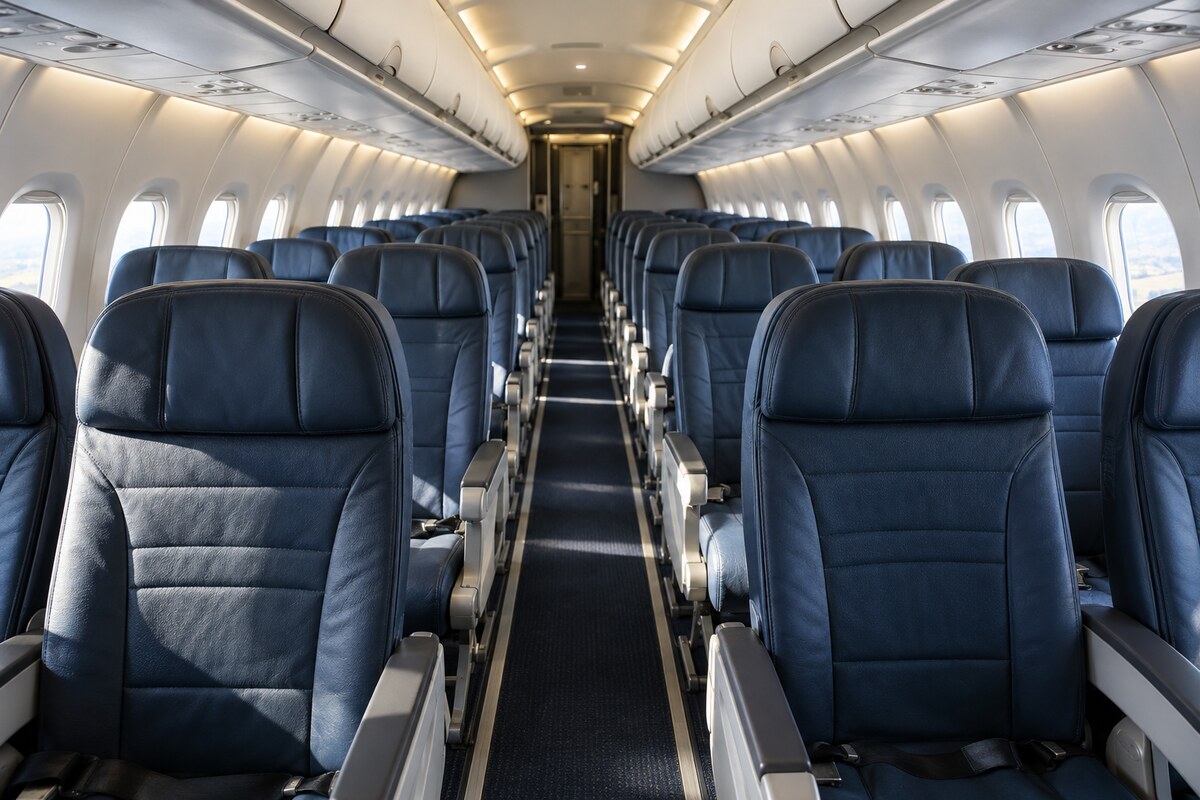
American’s larger regional aircraft commitment
American Airlines placed a firm order for 90 E175s on 4 March 2024 and retained purchase rights for 43 more. Embraer said the firm orders would enter its first-quarter 2024 backlog, with deliveries beginning in 2025. The maximum transaction, if every right were exercised, exceeded US$7 billion at list prices. The 133-aircraft headline combined the 90 firm orders with conditional rights, rather than describing 133 unconditional purchases.
The aircraft were specified with 76 seats in American’s standard two-class layout. American intended to replace its remaining 50-seat, single-class regional aircraft by the end of the decade and continue serving small and medium-sized markets with larger regional jets. The airline expected a dual-class regional fleet after completing the new E175 deliveries. Chief executive Robert Isom connected the purchases with fleet modernisation and simplification. Embraer Commercial Aviation president Arjan Meijer called it American’s largest single E175 order. The retirement programme and resulting fleet composition were forward plans at the announcement date.
Freighter conversion reaches flight testing
The first passenger-to-freighter E190F completed its maiden flight on 5 April 2024 at São José dos Campos in Brazil. The aircraft belonged to Regional One, a leasing company from the United States. Embraer’s crew flew for approximately two hours while evaluating the converted aircraft. It had already completed ground pressurisation and cargo-loading tests. Further testing was still required before the freighter could enter operation.

Embraer launched the E190F and E195F passenger-to-freighter conversion programme in 2022. More than 40 suppliers and over 600 employees participated, with over half a million working hours devoted to the programme. Embraer specified maximum structural payloads of 13,500 kilograms for the E190F and 14,300 kilograms for the E195F when combining the main deck and underfloor capacity. Chief executive Francisco Gomes Neto associated the programme with demand for cargo transport linked to e-commerce. These converted passenger aircraft formed a separate programme from deliveries of newly manufactured commercial passenger jets.
Investment and staffing plans during 2024
Embraer announced plans on 26 April 2024 to invest approximately US$390 million and recruit 900 additional employees during that year. Brazilian president Luiz Inácio Lula da Silva visited the company’s São José dos Campos headquarters for the announcement. The proposed spending covered research and development, industrial expansion, efficiency projects, defence and security, and services including passenger-to-freighter conversion. New technologies included work associated with electric vertical take-off and landing vehicles.
Around 90% of the proposed recruitment was assigned to operations. Roles included mechanics, electricians, milling workers, moulders, aircraft maintenance technicians and quality technicians, alongside production trainees receiving internal training. Engineering and administrative vacancies were also planned. Embraer had added 1,500 employees during 2023 and returned to its pre-pandemic employment level. At the April announcement it employed approximately 19,000 people directly worldwide, with 88% based in Brazil. The 900 additional positions and US$390 million investment were plans for 2024; the announcement did not establish their completion. President and chief executive Francisco Gomes Neto linked the programme to growth, efficiency and innovation.

The midyear delivery and backlog position
Embraer delivered 47 aircraft in the second quarter of 2024, compared with 25 in the first. The 18 July update divided those deliveries into 19 commercial jets, 27 executive aircraft and one C-390. Commercial aviation’s backlog reached US$11.3 billion, and the company-wide backlog was US$21.1 billion. Mexicana de Aviación ordered 20 E2 aircraft: ten E190-E2s and ten E195-E2s. Deliveries to the Mexican state-owned airline were scheduled to start in the second quarter of 2025.
Other commercial milestones included Scoot receiving and beginning operations with its first E190-E2, and Embraer delivering its 1,800th E-Jet in May. The milestone aircraft went to lessor Azorra for operation by Royal Jordanian Airlines. Executive aviation ended June with a US$4.6 billion backlog, while services and support stood at approximately US$3.1 billion. Defence and security had US$2.1 billion. Portugal received its second C-390 during the quarter under its 2019 agreement for five aircraft, which also included support and a flight simulator.
Midyear profitability and working capital
Second-quarter 2024 revenue reached US$1,494 million, increasing 67% over the first quarter. Adjusted EBIT was US$138.8 million, producing a 9.3% margin, compared with US$6.8 million and 0.8% in the preceding quarter. Commercial aviation revenue rose 176% sequentially. These financial figures were published on 8 August 2024, after the July delivery update, and related to April–June rather than the full calendar year.

Adjusted free cash flow excluding Eve was negative US$215 million. Embraer attributed that cash outflow to working-capital requirements associated with preparing for more deliveries in the second half. Management reiterated its annual guidance at that point: 72–80 commercial deliveries, 125–135 executive deliveries and revenue of US$6.0–6.4 billion. The adjusted EBIT margin target remained 6.5–7.5%, with adjusted free cash flow of at least US$220 million. Management considered opportunities and risks evenly balanced around those estimates. The quarterly negative cash-flow figure and the positive full-year target concerned different reporting periods.
Luxair exercises its two options
Luxair exercised the two options from its 2023 agreement on 17 December 2024, increasing the firm E195-E2 order to six aircraft. Three purchase rights remained, with conversion rights to the E190-E2. The additional order secured delivery slots in 2027. It represented two newly firm aircraft in addition to the original four, rather than six new orders on top of the earlier commitment.
Luxair selected 136 seats in a single-class, two-by-two cabin using Recaro seating available as supplier-furnished equipment. Gilles Feith remained chief executive, while Embraer’s European and Central Asian sales and marketing head Marie-Louise Philippe represented the manufacturer. The announcement’s operational schedule placed the first aircraft from the original order in early 2026, differing from its original fourth-quarter 2025 target. A quoted executive comment on the same page referred instead to the following year, 2025. These inconsistent timing statements do not establish an actual delivery date; the additional 2027 slots remained scheduled capacity.

The completed 2024 delivery result
Embraer’s 7 January 2025 delivery update recorded 206 aircraft for the completed 2024 calendar year, 14% more than the 181 delivered in 2023. Commercial aviation supplied 73 aircraft, executive aviation 130 and defence and security three C-390s. The commercial result fell within the original 72–80 guidance and reached the top of a subsequently revised 70–73 range. Executive deliveries finished at the midpoint of the original 125–135 target.
The final quarter accounted for 75 aircraft, matching the fourth-quarter total in 2023 and increasing 27% from the 59 delivered in the third quarter of 2024. It comprised 31 commercial and 44 executive aircraft. For the year, commercial deliveries rose 14% and executive deliveries 13%, while C-390 deliveries increased from two to three. These completed deliveries are distinct from the earlier order and investment announcements. The dated totals connect the 2023 delivery shortfalls, the following year’s original guidance and the aircraft that Embraer ultimately handed over in 2024.




















Leave a comment