
Hexagon’s Waygate agreement and its manufacturing inspection portfolio
Hexagon’s planned Waygate purchase would add internal inspection technologies to a portfolio spanning coordinate measurement, portable scanning and production software.
Hexagon agreed on Apr 13, 2026, to buy Waygate Technologies from Baker Hughes for approximately $1.45 billion in cash. The proposed purchase would bring industrial computed tomography, radiography and remote visual inspection into its Manufacturing Intelligence business. Baker Hughes was selling the Hürth, Germany-based inspection operation as it reshaped its Industrial & Energy Technology portfolio and directed investment towards growth businesses. Hexagon announced the agreement in Stockholm.
The Waygate agreement remained subject to approvals and customary conditions, with completion expected in the second half of 2026. Hexagon intended to use cash and existing debt capacity. Waygate generated approximately $630 million in fiscal 2025 revenue. Hexagon expected manufacturing localisation and cross-selling to improve its margins; those were prospective measures. The acquisition would extend a portfolio already covering surface measurement, inspection software and portable testing.

A digital coordinate measuring machine
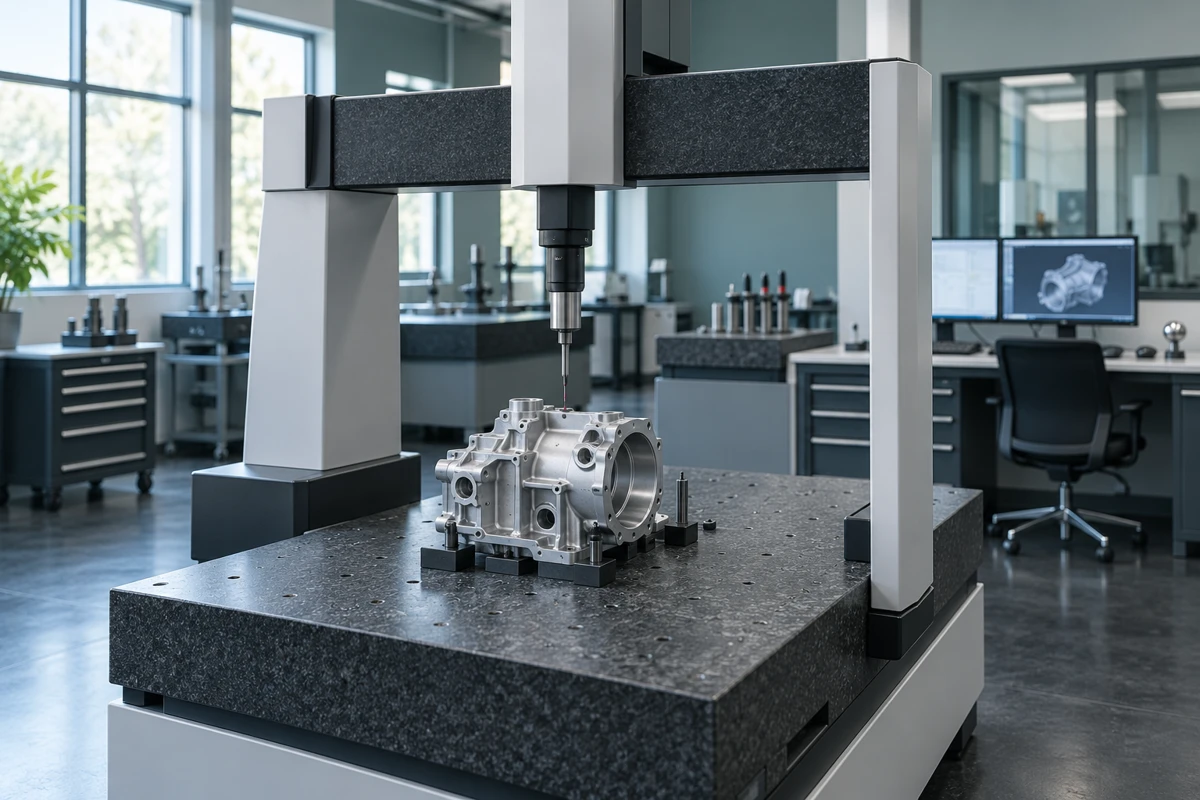
MAESTRO, introduced on May 6, 2025, was a new coordinate measuring machine platform developed around digital sensors, a single cable system and a new controller with new firmware. Hexagon designed its modular hardware and software for aerospace, automotive and other precision manufacturing applications. The platform combined tactile probes and laser scanning probes in automated multi-sensor workflows. A digital probe rack tracked occupancy and sensor supply health, making that information available on the machine and through desktop and cloud applications.
MAESTRO connected to Nexus so that design, production and quality teams could share measurement data. The system supported integration near production lines or within automated lines, while its modular architecture allowed later software, sensor and capability upgrades. Hexagon developed PC-DMIS and the Metrology Mentor, Metrology Asset Manager and Metrology Reporting applications alongside the machine. The company announced an order opening of Jun 30, 2025, with several sizes and configurations planned.

Monitoring the conditions around measurement
PULSE added environmental information to coordinate measurement. The upgrade announced on Mar 30, 2026, monitored temperature, humidity, vibration, shock and probe deflection, extending sensing beyond the CMM itself. The additional probe information helped operators distinguish general vibration or shock from a probe collision that might require recalibration. In production areas, where conditions vary more than in a controlled measurement room, that distinction supported decisions about whether equipment needed intervention. Hexagon positioned the system for production-adjacent and unattended inspection workflows.
The included Metrology Communication Interface made PULSE data available to programmable logic controllers, manufacturing execution systems, dashboards and automation software. The upgraded platform supported deployment across Hexagon CMMs and mixed fleets, with a modular architecture intended to accommodate further sensors. Orders opened on Mar 30, 2026. New customers could buy the complete solution; existing users could update sensors and software through a plug-and-play upgrade. Hexagon described a typical installation time of five minutes without specialist service support, a company estimate rather than a guaranteed duration at every site.
Programming, reporting and equipment status
The Autonomous Metrology Suite, introduced on Jun 16, 2025, brought several inspection tasks into a shared Nexus interface. A digital twin represented each connected CMM and synchronised with the physical equipment to route inspection programmes to the appropriate machine. Quality, utilisation and environmental information fed a cloud dashboard. The suite connected Hexagon's Global S, Tigo and MAESTRO machines to the same workflow, while support for third-party hardware remained planned. Its programme generation, deployment, execution and reporting functions were organised around three applications:
- Metrology Mentor generated inspection programmes from CAD using ISO and ASME requirements.
- Metrology Reporting combined dimensional measurement and tomography results, batch analytics and part histories.
- Metrology Asset Manager monitored calibration, operation, errors, environmental conditions and equipment utilisation.
The launch provided for pilot customer availability in June and full commercial availability later in 2025. On-premise software would synchronise programmes, machine twins and reports with Nexus and execute CMM programmes without an explicit requirement for PC-DMIS. Early adopter Paragon Medical described deployment across a fleet of 17 CMMs.

Adjusting optical scanning to the part
The SmartScan VR800 structured light scanner, launched on Apr 9, 2024, combined four 20-megapixel cameras in a dual stereo arrangement with an optical zoom projection unit. Operators could change measurement volume and data resolution in software instead of replacing optics mechanically. Smart Resolution, Smart Zoom and Smart Snap controlled those choices. Different resolutions could be combined within one inspection project, allowing small, detailed features to receive denser coverage while larger areas used less data. The integrated controller pre-processed scans before transfer to metrology software.
Smart Snap paired a high-resolution scan from the smaller-base camera pair with an alignment image from the larger-base pair. Hexagon designed that combination to reduce the need for overlapping, data-intensive scans when assembling a mesh. The carbon fibre frame supported thermal stability. Applications included turbine blade edges, cast or moulded parts and tooling that combined fine features with larger surfaces. A turntable or turn-tilt unit enabled semi-automated measurement, and the scanner supported robot or cobot integration. It was available to order through local representatives at launch.

Laser tracking for large structures
The Leica Absolute Tracker ATS800 became globally available on May 7, 2025. It combined direct, reflectorless scanning at distances of up to 40 metres with reflector tracking in one portable instrument. Its TruePoint Interferometer supported measurement of features such as edges, holes, slots and threads without physical contact. FeatureDetect used CAD information or the instrument's panoramic camera to recognise geometries and reduce manual programming. The same device could track moving components during assembly and scan stationary structures for inspection, including aerospace and wind energy applications.
The tracker worked with PC-DMIS, SpatialAnalyzer and third-party metrology software. Its SDK supported robotic integration, while mounting options included inverted installation, mobile robots, gantries, lifts, rails and robot arms. PowerLock reacquired moving reflectors for tracking during assembly. Hexagon also planned to use the ATS800 in PRESTO quality stations with two-axis positioning for automotive chassis inspection. The company promoted unattended inspection and shorter setup times; the launch did not establish a universal cycle-time reduction for every part geometry, installation or automated workflow.

Portable testing with encoded positions
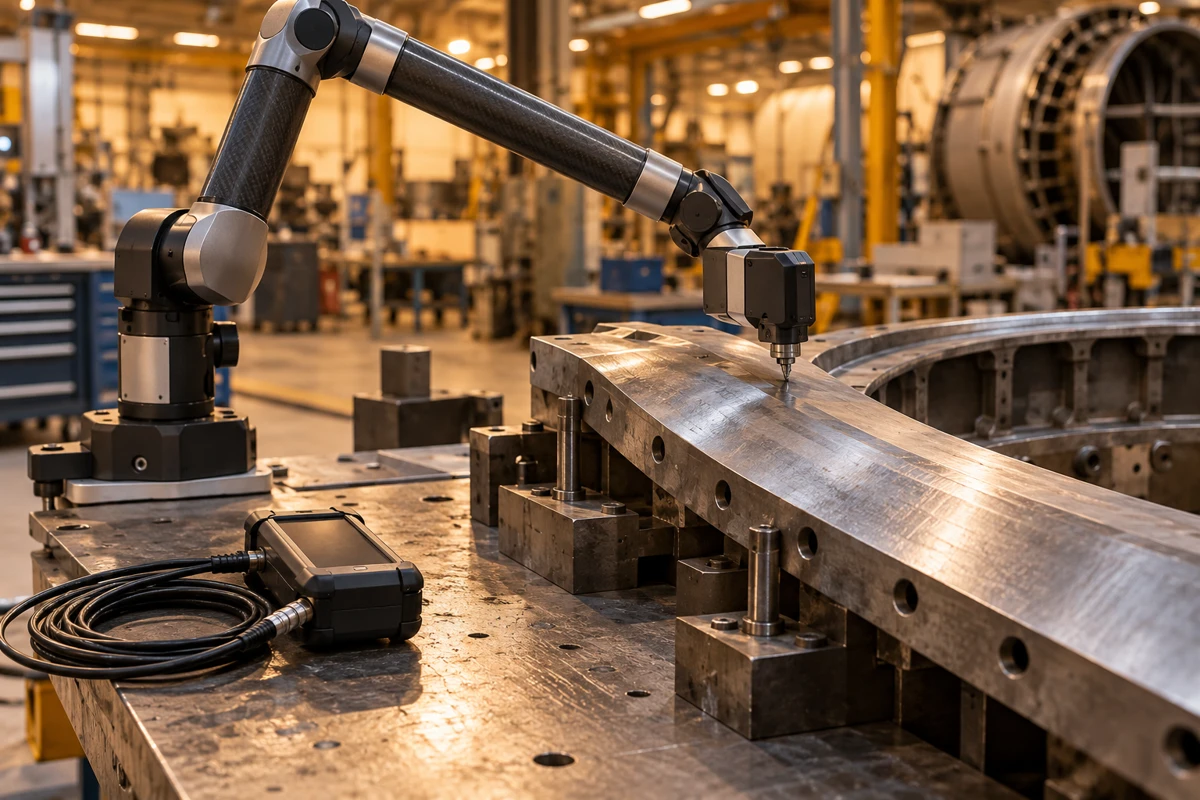
Hexagon's relationship with PRAGMA already combined dimensional measurement and non-destructive testing before the Waygate agreement. On May 20, 2025, the companies expanded their partnership through a distribution arrangement covering the United States, Canada and Mexico. PRAGMA instruments and sensors integrated with Hexagon Absolute Arms and Leica laser trackers to position inspection information in three-dimensional coordinate space. Engineers could relate internal defect images to a digitised surface or CAD model while taking equipment to the component, rather than removing the component for inspection elsewhere.
The combined applications included thickness monitoring, corrosion mapping, spot weld inspection, composite flaw detection, additive manufacturing validation and examination of full-penetration welds. The modular Absolute Arm RA8 could accept additional sensors for both metrology and testing tasks. Hexagon planned specialised aerospace and automotive kits and retrofit options for existing arm and tracker users. PRAGMA identified metal alloys and advanced composites among the materials its technology could examine. Its statement that flaws as small as 0.25 millimetres could be detected applied only in some cases, rather than defining a general detection limit.
Geomagic joined the software portfolio
Hexagon announced its agreement to buy the Geomagic software business from 3D Systems on Dec 12, 2024, for $123 million on a cash- and debt-free basis. The business had approximately 100 employees and generated around $30 million in revenue in 2023. Its Design X, Control X, Freeform and Wrap products processed three-dimensional scan data and supported different stages of design and inspection. Capabilities included turning measurements of physical objects into digital models and creating history-based parametric CAD models for manufacturing applications.
The software also supported initial freeform design, modification of existing CAD models and measurement of finished parts for quality control. Hexagon intended to combine these capabilities with its portable metrology sensors. On Apr 2, 2025, it announced completion after regulatory approvals and customary closing conditions had been satisfied. Geomagic would operate within Manufacturing Intelligence and be consolidated from April 2025.

Organic design and haptic input
Geomagic Freeform 2026.1 added tools for sculptural and organic forms used in toys, packaging, orthotics, prosthetics and mould design. The release published on Mar 16, 2026, introduced Deform Selection, which moved, rotated or scaled a selected model region while neighbouring areas deformed smoothly. Python scripting extended the existing Dynabot automation functions through the Geomagic API. Hexagon illustrated this with a workflow that generated a manufacturing mould after a cranial implant plate had been designed.
The software added support for Haply Robotics' Inverse3 and portable MinVerse haptic input devices, giving designers force-feedback interaction with digital forms. Healthcare workflows gained DICOM RTSTRUCT support for preparing bolus device designs for three-dimensional printing. Freeform 2026.1 was available through Hexagon sales teams and authorised resellers. A subscription option accompanied the perpetual licence model. Hexagon put the reduction in starting cost at 66%; that figure concerned entry pricing and did not establish the same reduction in a customer's total ownership or manufacturing costs.

Inspection from hairpins to large pipework
BendingStudio XT's Mar 18, 2026, update extended tube and wire measurement across fixed cells and handheld scanning. TubeInspect could inspect multiple identical parts simultaneously and provide an immediate green or red assessment. It also sent correction data back to bending machines. The software added specialised correction reports for electric motor hairpins, while a new CAD Adapter supported rectangular profiles such as electric vehicle busbars. Fittings, brackets and end forms could be compared with design data to check their position and orientation.
ATLASCAN Pro integration offered a portable option for smaller fabricators and for parts measured in their installed position. HYPERSCAN supported larger industrial pipework and exhaust systems, including tube geometries up to 5.5 metres long. Those options allowed operators to take the scanner to the part, alongside the dedicated TubeInspect approach for series production. Hexagon made the updated software available immediately. It described TubeInspect's temperature compensation and ISO 17025-certified calibration as part of its shop-floor measurement capabilities, alongside operation in oily, dusty or high-temperature environments.
Preparation and quoting for sheet metal
RADAN reached its fiftieth anniversary on Mar 9, 2026. First developed in 1976 for offline verification of punch press programmes, it expanded across punching, profiling, nesting and bending. Machine-specific logic, tooling information and verified workflows supported preparation for different fabrication equipment. The software linked costing and quoting with manufacturing preparation and toolpath verification before material was committed. Its development priorities included removing repetitive preparation work, strengthening traceability and retaining validated programmes as new capabilities were introduced into existing production processes.
At the UK fabricator Lasershape, RADAN provided the production logic behind Hyperlight, a continuously available automated quoting and ordering platform. The implementation used the RADAN API for part validation, geometry clean-up and nesting, with additional operational rules reflecting machine performance. Lasershape reported an approximately 15% reduction in material waste and improvements in profiling times for three-millimetre aluminium sheets. Those results belonged to that customer's implementation. Its quoting capacity moved beyond manual office hours, while the company described redeploying staff towards engineering work as an objective of the automation.
Preparing complex machining programmes
The ESPRIT EDGE capabilities announced on Apr 1, 2026, extended ProPlanAI into turning, mill-turn and Swiss machining. The programming system considered stock removal and earlier machining strategies. Multiple guide bushing configurations became part of machine models, allowing a change to chucker mode without rebuilding the machine definition. Improved collision detection accounted for tool holders during advanced three-axis turning when orientation changed through B-axis movement or Y-axis control. Five-axis composite machining also gained automated tool motion generation without a requirement for external drive surfaces.
A redesigned cloud connector brought documentation, community resources and software extensions into a clearer navigation structure. Knowledge-based machining updates added control over feed definitions in drilling cycles, including the use of non-drilling tools. A U-axis turning capability remained a preview with pilot users being recruited: it would rotate a tool around a stationary part, using a programmable linear axis to control diameter. The wider release was available globally from March 2026. It was the first of four updates planned for the year, rather than completion of the whole annual roadmap.
Connecting engineering and manufacturing tools
Nexus launched on Feb 23, 2023, as a platform for connecting people, software and machines across discrete manufacturing. Its scope included aerospace, automotive, electronics, consumer products and general manufacturing. Engineering, production and quality teams could exchange information in real time across workflows. Co-engineered with Microsoft, the platform connected cloud services with on-premise systems and allowed customers to select which tools they linked. Hexagon described secure information sharing and intellectual property protection as platform capabilities, alongside access to training and support.
The launch included connections with third-party technologies such as Oqton's manufacturing execution system and Altium's Altium 365 electronic design platform. Nexus-supported applications could use shared visualisation, AI and workflow orchestration capabilities. Customers could combine selected Hexagon products with partner tools instead of adopting a single predetermined software stack. The platform was intended to support collaboration across product development and production, including earlier evaluation of design choices. Hexagon's stated aims included lower waste and rework and more sustainable workflows; these were intended benefits, rather than quantified outcomes established at launch.
A wider set of connected applications
By Mar 31, 2025, Nexus had attracted more than 30,000 registered users, according to Hexagon. The figure represented registrations rather than paying customer organisations. Nexus Compute provided on-demand access to CAE simulation solvers, and Virtual Test Drive X supported cloud simulations for advanced driver assistance and autonomous vehicle software testing. Integration options ranged from file exchange to real-time sharing using Microsoft's Fluid Framework. The architecture connected engineering simulation and product data systems with production systems, shop-floor sensors and quality information sources.
Nexus connected with PC-DMIS, VGSTUDIO MAX and QUINDOS for quality data workflows, alongside ESPRIT EDGE, EDGECAM, DESIGNER and VISI production software. Its partner ecosystem included Acerta LinePulse, CASTOR, Instrumental, JITbase, MachiningCloud, Moldex3D, OCTOPUZ and Zaptic. Data and integration resources included Materials Connect and the Solera VTD Catalog. Hyundai Motor described using Nexus with Hexagon's CAE tools as part of its cloud-based vehicle development strategy. Path Machining described applying accumulated machining knowledge through ProPlanAI. Both accounts were customer statements about their own uses of the platform.




















Leave a comment