
Nokia and Infinera: the acquisition and its optical-network roadmap
Nokia won unconditional EU approval for its Infinera acquisition, targeting greater optical-networking scale and more sales to major data-centre customers.
Nokia received unconditional European Commission approval on Feb 26, 2025, for its $2.3 billion acquisition of Infinera, the American optical-semiconductor and networking-equipment supplier. The Commission concluded that the companies’ combined position in optical transport equipment would remain moderate and that credible competitors would continue to constrain the business. The clearance covered the competition assessment of the combination; Nokia still had to complete the transaction. The deal had been announced the previous June, when the companies agreed to bring Infinera into Nokia’s optical-networking business.
Reuters estimated that the acquisition would create the second-largest optical-networking vendor, with a 20% market share, behind Huawei. Huawei benefited from Western suppliers’ limited presence in China. Nokia also sought more equipment sales to Amazon, Alphabet and Microsoft as those companies invested in data centres for artificial intelligence. Those commercial opportunities formed part of the deal’s rationale, rather than completed customer orders at the clearance date.
The offer, consideration and completed acquisition
The original agreement, dated Jun 27, 2024, valued Infinera at $6.65 per share and an enterprise value of $2.3 billion. Shareholders could elect $6.65 in cash, 1.7896 Nokia shares, or a mixture of $4.66 and 0.5355 Nokia shares for each Infinera share. Nokia shares would be delivered as American Depositary Shares. Proration limited the equity component to approximately 30% of total consideration, with at least 70% paid in cash. The offer represented a 28% premium to Infinera’s previous closing share price and 37% to its trailing 180-day volume-weighted average.
Nokia expected roughly $760 million to repurchase Infinera’s convertible notes, including estimated change-of-control costs; that amount was already included in the announced enterprise value. The company also planned additional buybacks to offset acquisition-related dilution. Its financial targets included €200 million of net comparable operating-profit synergies by 2027 and approximately €200 million of one-time integration costs. About one-third of the targeted synergies would come from cost of sales, with the remainder from operating expenses. These were the company’s expectations when it signed the agreement.
Nokia completed the acquisition on Feb 28, 2025. Infinera joined Optical Networks, then headed by Vice President and General Manager James Watt. Infinera chief executive David Heard became Chief Strategic Growth Officer in Nokia’s Network Infrastructure business group, with responsibilities covering customer-segment strategies, product and market mix, and routes to market. The combined company served more than 1,000 customers globally, including telecommunications operators and organisations in enterprise, utilities, government, research and education.

At completion, Nokia reaffirmed its expectation that the transaction would increase comparable operating profit and earnings per share in 2025. It continued to target more than €200 million in net comparable operating-profit synergies by 2027, building gradually over three years, and more than 10% comparable earnings-per-share accretion in 2027. Those targets remained forward-looking measures. The closing announcement also identified customer diversification and a larger North American presence as objectives for the expanded optical business, alongside faster product development.
Infinera’s final standalone annual results
Infinera entered the combination after a year of lower revenue and larger accounting losses. For its fiscal year ended Dec 28, 2024, revenue was $1,418.4 million, compared with $1,614.1 million in 2023. Its GAAP gross margin was 38.4%, against 38.6%, while its GAAP operating margin moved to negative 5.9% from negative 0.3%. The annual GAAP net loss widened to $150.3 million from $25.2 million. On the company’s non-GAAP basis, operating margin was 0.3%, compared with 5.4%, and the net loss was $43.8 million, against a $53.4 million profit.
Fourth-quarter revenue reached $414.4 million, above the preceding quarter’s $354.4 million but below the year-earlier $453.5 million. The quarter produced a $26.3 million GAAP net loss and $8.2 million of non-GAAP net income. Infinera’s book-to-bill ratio was approximately 1.1 for the full year and 1.3 for the fourth quarter. Direct and indirect exposure to webscale customers exceeded half of annual revenue. Its non-GAAP measures excluded specified items, including share-based compensation, restructuring and merger-related charges; they supplemented the GAAP results.

The first integration update
By Apr 24, 2025, Nokia had begun integration and communicated important product-roadmap decisions to customers in early April. Chief executive Justin Hotard reported 15% first-quarter sales growth in the expanded Optical Networks business and 11% in Network Infrastructure, both on a constant-currency and portfolio basis. He also highlighted hyperscaler design wins. These growth measures adjusted the comparison for currency and portfolio changes, rather than treating the addition of the acquired company’s revenue as organic expansion.
Nokia’s first-quarter acquisition disclosure recorded ownership of all Infinera equity and voting rights. Total purchase consideration was €2.5 billion, comprising cash, Nokia depositary shares, the value of replacement share awards attributable to pre-combination service, and convertible-note fair values under the relevant indentures. The company introduced a constant-currency and portfolio sales-growth measure that assumed specified acquisitions had been owned in both comparison periods and disposals had already occurred. The accounting consideration therefore had its own stated components, alongside the earlier dollar-denominated enterprise-value announcement.
A subsequent customer selection brought the combined optical portfolio into EXA Infrastructure’s terrestrial network plans. On May 2, 2025, EXA chose Nokia’s 1830 Global Express platform and ICE7 coherent optics for a 1.2-terabit-per-second-per-channel upgrade. London-based EXA then owned 155,000 km of fibre across 37 countries, including six transatlantic cables. The announced modernisation addressed connectivity between major data centres as well as the wider international network. EXA’s existing infrastructure used the earlier ICE6 technology.

Terrestrial and submarine customer programmes
Nokia projected that the EXA upgrade could increase network capacity by as much as 15% while cutting power and cost per bit by as much as 50%. Those figures described the expected upgrade benefits in the announcement. EXA Chief Operating Officer Ciaran Delaney emphasised the transition from ICE6 and the ability to support growing bandwidth requirements. Nokia’s James Watt linked lower power consumption per bit to the constraints that electricity requirements could place on data-centre growth.
Cybernet selected the 1830 GX platform and ICE7 for a different network on May 7, 2025: a new long-haul backbone in Pakistan. The initial phase was planned to connect more than 25 cities, provide more than 50 Tbps of long-haul capacity and support 1.2 Tbps per wavelength. Intended uses included data-centre interconnection, enterprise and carrier networks, and Cybernet’s StormFiber residential broadband service. Cybernet also served international telecommunications operators through carrier and transit services, alongside domestic enterprise, corporate and residential customers. Integrated optical line-system capabilities formed part of the selected Nokia platform. Diverse routes would also support cross-border transit for carriers and internet service providers in Central Asia. Cybernet Chief Operating Officer Maroof Ali Shahani described the equipment as the foundation for future high-capacity services. Nokia’s announcement presented the backbone as a deployment and modernisation programme, with its geographic coverage and service benefits still to be delivered.
On Jul 28, 2025, Nokia announced another selection for Medusa, an open-access submarine system owned by AFR-IX Telecom. The project was intended to connect the Atlantic coast, Mediterranean Sea and Red Sea, serving countries including Morocco, Tunisia, Libya, Algeria and Egypt. Nokia’s 1830 GX platform and ICE7 optics would provide transmission measured in tens of terabits per second per fibre pair. That measure described a fibre pair’s capacity, distinct from a single wavelength’s rate. The system was designed to give telecommunications providers access to connectivity supporting 5G, cloud infrastructure and growing AI-related demand. Medusa co-founder and Chief Technology Officer Miguel Angel Acero forecast scalable services and lower customer costs; the announcement did not establish completion of the entire cable network.

Product availability and later operating updates
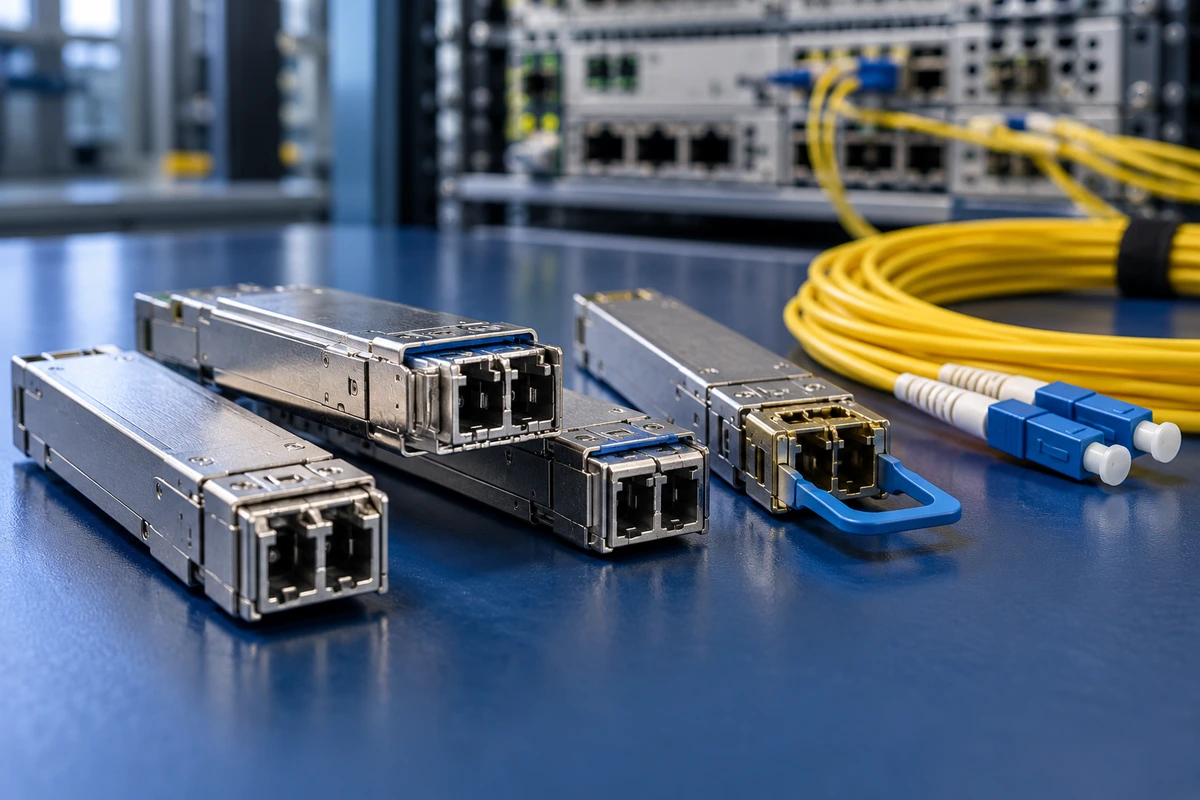
By the third quarter of 2025, Nokia’s new 800G ZR/ZR+ pluggables for data-centre interconnection had become generally available and begun shipping to a large American customer. Hotard disclosed the shipments on Oct 23, 2025, alongside 19% Optical Networks sales growth and 11% Network Infrastructure growth on a comparable, constant-currency and portfolio basis. Optical and IP order intake remained strong, with book-to-bill well above one. AI and cloud customers accounted for 6% of Nokia group sales and 14% of Network Infrastructure sales in the quarter.
Nokia also planned a second indium-phosphide semiconductor fabrication facility in San Jose before the end of 2026 to support its optical-components business. That was a future manufacturing milestone in the third-quarter update. A strategic partnership with Nscale would make Nokia a preferred networking-equipment vendor for Nscale’s data-centre buildout. Both developments accompanied the wider optical growth programme: one expanded planned production capability, while the other concerned a customer’s future infrastructure purchases.
For the fourth quarter of 2025, Nokia reported 17% Optical Networks sales growth and 7% Network Infrastructure growth on a comparable, constant-currency and portfolio basis. Orders in optical and IP remained above sales, supported by AI and cloud demand. Within Network Infrastructure, Fixed Networks sales were flat: 16% growth in fibre optical line terminals was offset by weakness in products Nokia was deprioritising. IP Networks made progress in expanding its presence inside data centres, supporting orders alongside the optical business. At group level, comparable operating margin declined 90 basis points to 17.3%, reflecting growth investments in Network Infrastructure, including Infinera integration. Reported operating margin fell 560 basis points to 8.8%, with higher restructuring charges. Nokia’s full-year comparable operating profit of €2.0 billion and free cash flow of €1.5 billion covered the whole group. The company also moved to two operating segments, Network Infrastructure and Mobile Infrastructure, at the start of 2026, as part of a broader organisational simplification.

Manufacturing investment and the 2026 update
Nokia announced a multiyear American investment plan on Nov 21, 2025, covering $4 billion in research, development and manufacturing. It was additional to the company’s $2.3 billion Infinera acquisition. Approximately $3.5 billion would go to research and development, with about $500 million in capital expenditure for manufacturing and research facilities in states including Texas, New Jersey and Pennsylvania. The programme extended across mobile, fixed access, IP, optical and data-centre networking, as well as mission-critical and defence solutions.
The same announcement identified an earlier $456 million Infinera investment for two American manufacturing facilities that had received CHIPS Act incentives. Nokia also included semiconductor manufacturing, testing, packaging, automation, quantum-safe networks and materials science within its intended investment activities. Its research presence included Nokia Bell Labs, headquartered in New Jersey, whose history encompassed work on the transistor and digital communications. The proposed research spending would support further connectivity and AI technologies across the company’s networking activities. The $4 billion commitment was a company-wide plan spread over multiple years, with future research and capital spending. Its scope extended beyond the acquired optical business and beyond the two facilities associated with Infinera’s earlier programme.
On Apr 23, 2026, Nokia reported 20% first-quarter Optical Networks sales growth and 6% Network Infrastructure growth on a constant-currency and portfolio basis. AI and cloud sales rose 49%, accounting for 8% of group sales, while orders from those customers reached €1 billion. Hotard described further design wins for pluggables and line systems. Nokia raised its estimate for addressable AI and cloud market growth to a 27% compound annual rate over 2025–2028, from 16% estimated in November. Hotard also described accelerating supply-chain demand and lengthening lead times as investment increased. The San Jose indium-phosphide facility remained on track to begin ramping production later in 2026. For the full year, Nokia assumed 12–14% Network Infrastructure growth, incorporating 18–20% combined growth in optical and IP. Group capital expenditure was expected to reach €900 million–€1 billion, primarily reflecting additional optical manufacturing capacity but also including property-renewal projects. These were the company’s updated assumptions and planned production timing.

A dated roadmap for the next optical products
Nokia’s Mar 16, 2026, optical announcement introduced a building-block approach using four digital signal processors and optical front ends based on indium phosphide and silicon photonics. The proposed products served different applications:
- 1.6T-capable coherent pluggables for IP-over-DWDM data-centre interconnection;
- 2.4T-capable pluggables for thin-transponder deployments;
- 3.2T-capable coherent-lite solutions for shorter campus and enterprise links;
- double-sided pluggables, full-band transponders, and embedded 2.4T and 3.2T transponders for other capacity and reach requirements.
Sampling of the coherent family was expected to start in mid-2027, with general availability beginning in the second half of that year. A separate multi-rail in-line amplifier was planned for the second half of 2026. Nokia specified 160 fibre pairs in one rack and a fortyfold amplifier-density increase relative to its stated existing solutions. The company also projected total-cost-of-ownership savings of up to 70% for the new coherent portfolio. Those figures and dates remained product claims and availability plans at announcement, rather than measured results across all customer networks.




















Leave a comment