
Panasonic’s Wakayama 4680 programme: production readiness and customer alignment
Panasonic’s Wakayama programme connects 4680 preparations with customer alignment and development research.
Wakayama prepares for a larger cylindrical cell
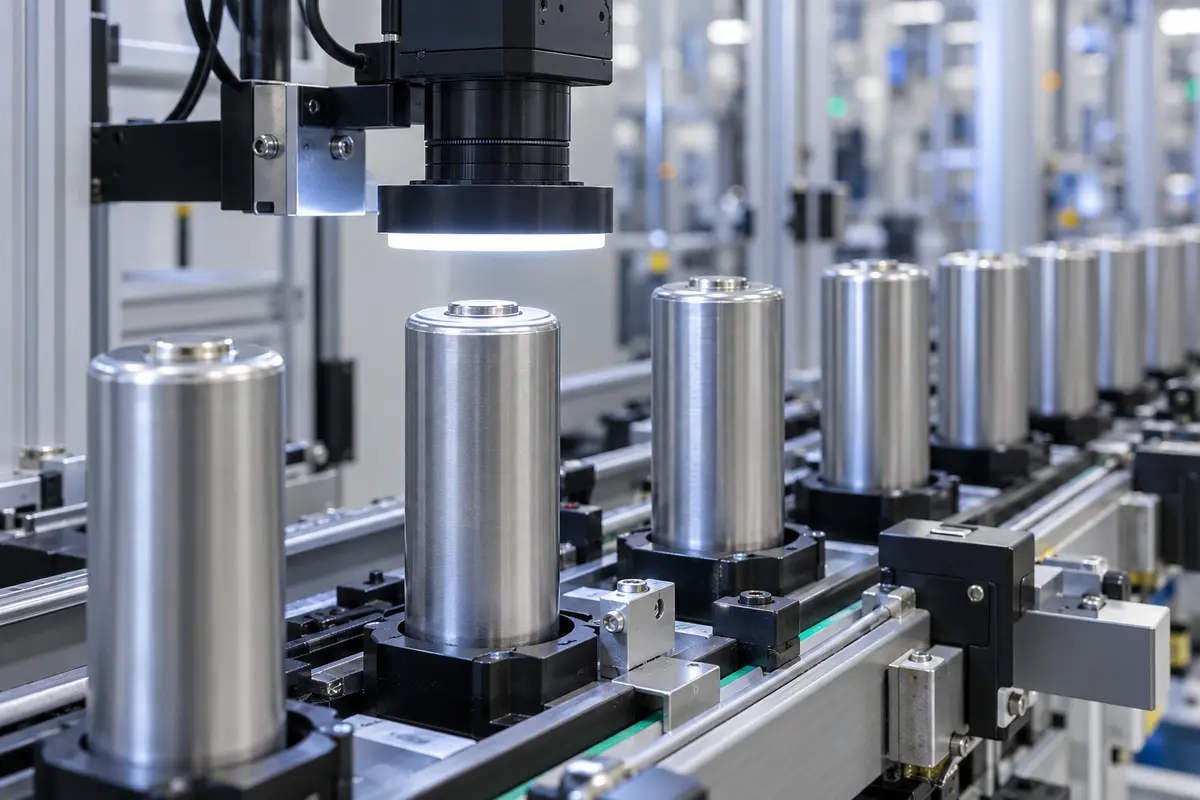
Panasonic Energy completed preparations for production of its 4680 electric-vehicle battery at Wakayama in September 2024, with customer approval still required before manufacturing could begin. Sample cells had already reached some existing automaker customers. Chief executive Kazuo Tadanobu put initial annual capacity at several gigawatt-hours, a planned scale rather than a disclosed volume of batteries already delivered. The factory had previously made battery components, and the company held a ceremony at which an inspection line was shown.
The cell measures 46 millimetres across and 80 millimetres high. Panasonic attributed roughly five times the capacity of its 2170 battery to the larger format. That comparison concerns the capacity of an individual cell. Customer approval remained outstanding on Sep 9, 2024.

A manufacturing hub in Kinokawa
The Wakayama factory, established in April 1991, occupies a 99,177-square-metre site at Uchita in Kinokawa, Wakayama Prefecture. Its building area is 60,907 square metres. Panasonic planned approximately 400 employees for development and production by the fiscal year ending in March 2025. Those figures distinguish the existing physical site from the workforce target attached to its new battery role.
Wakayama was also intended to serve as a demonstration and manufacturing-development hub, with processes established there subsequently deployed globally. Final evaluations preceded mass production. By September 2024, Panasonic said all nine of its domestic production bases had achieved carbon neutrality. The company distinguished that domestic position from its longer-term worldwide target. Solar and onshore wind power formed part of the company's ambition for virtually zero carbon dioxide emissions during production. Panasonic's Sep 9, 2024 announcement placed that ambition alongside a target for carbon neutrality at all 20 worldwide production bases by March 2029; it was a production-site programme with its own scope.
The development programme preceding the conversion
Panasonic's June 2023 energy strategy placed Wakayama's 4680 production start in the first half of the fiscal year ending in March 2025. Equipment delivery and preparations to bring the equipment into operation were proceeding alongside work on higher energy density. The company planned to combine materials, process and product development at Kadoma, while expanding manufacturing-process and equipment development at Suminoe.
Digital simulation was part of that development programme. Panasonic targeted an increase of 1,000 technical employees in Japan by the fiscal year ending in March 2026, compared with the year ending in March 2023. Its longer-range materials roadmap aimed at 1,000 watt-hours per litre by the fiscal year ending in March 2031, approximately 25% above the stated starting point. That was a future technology objective; it was not a measured specification for the Wakayama 4680 cell.

Regional production and the energy-density roadmap
By June 2024, Panasonic's energy strategy put the planned 4680 start at the end of the second quarter of the fiscal year ending in March 2025. Its production plans combined a focus on Japan with North America. The Japanese programme included a planned transition from 1865 to 2170 cells in Osaka and the separate introduction of 4680 cells at Wakayama.
The 800-watt-hour-per-litre figure in that strategy belonged to planned 2170 production in Kansas. Panasonic envisaged applying the relevant technology to 4680 cells subsequently. The same strategy divided its battery lifecycle carbon footprint between manufacturing and upstream activities: for the fiscal year ending in March 2022, its own production represented 14% and upstream activities 86% within the company's stated calculation. Those percentages concern that lifecycle assessment, with a different boundary from an individual factory's operational emissions.

Suminoe's process-development equipment
Panasonic completed a new production-development facility at its Suminoe factory in Osaka in April 2024. The four-storey building has a floor area of approximately 7,900 square metres. Its first floor supports advance verification of large equipment and electrode processes; electrode development occupies the second floor, while the third supports assembly development. Offices occupy parts of the third and fourth floors.
Approximately 400 production engineers were expected to work there. Development tasks included improving winding and welding, validating dry-coating processes and analysing factory data. Material-handling and equipment-layout simulations were intended to support the introduction of production lines. Dry coating was an area of validation, rather than a confirmed description of Wakayama's operating process. Panasonic also planned a combined development workforce of approximately 1,100 with a cell-development facility at Nishi-Kadoma then expected to open in April 2025.

What a manufacturing-cost model measures
A 2024 study by Hendrik Pegel and colleagues modelled production costs for cylindrical batteries with different formats and housing choices. Under an assumed annual output of 40 gigawatt-hours, the transition from 2170 to 4680 reduced estimated costs from $107.88 to $96.12 per kilowatt-hour, a 10.9% reduction. The model connected that result to fewer individual cells for a given energy output and a lower share of inactive components.
The calculation depended on its manufacturing assumptions, including how housings were produced. The researchers considered deep-drawn steel and backward-impact-extruded aluminium, with uncertainty in the parameterisation of the smaller aluminium housing. Their work was published online on Jul 27, 2024 in the Journal of Energy Storage. Its cost figures describe a modelled production scenario. Wakayama's actual output, unit costs and realised savings were not measurements supplied by that study.

Cooling depends on the cell and its connections
Christian Allgäuer, Fabian Grenz, Kareem Abo Gamra and Markus Lienkamp examined thermal management of a steel-housed, tabless 4680 reference cell in a study in the Journal of Energy Storage's Sep 20, 2025 issue. Their experiments found that side cooling performed better than bottom cooling when assessed using the surface-temperature measure employed in the investigation. The study also examined the interaction between cell construction and cooling arrangements through modelling.
Tab conductivity and the housing influenced thermal performance alongside the cooling method. Heat generated by electrical contact resistance at busbar connections was another relevant factor. These findings concerned the reference cell and conditions investigated by the researchers. The accessible institutional abstract does not establish measurements of Panasonic's Wakayama product. Its distinction between cell design, cooling and electrical connections keeps the engineering discussion tied to the particular system under examination.
Simulating a larger format from an experimentally tested model
Shen Li, Mohamed Waseem Marzook, Cheng Zhang, Gregory J. Offer and Monica Marinescu investigated how cooling and current-collector design affect cylindrical cells in a study available online on Aug 2, 2023. Their model was validated against experiments on a single-tab LG M50T 2170 cell, using different states of charge, currents and temperatures. They then used the model to simulate a larger tabless 4680 configuration.
The work examined heat transfer between the internal jelly roll and the can, as well as the role of continuous current collectors. Its simulated larger cell was a separate stage from experimental validation on the smaller commercial cell. Cooling comparisons therefore depend on which configuration and boundary conditions are being considered. The Applied Energy study provides engineering context for scaling a cylindrical format, with conclusions bounded by the model's assumptions.

Silicon materials and a separate capacity target
Panasonic agreed in December 2023 to procure silicon anode material from Sila Nanotechnologies, based in Alameda County, California. Sila's Titan Silicon material was to be supplied from Moses Lake, Washington. The agreement formed part of Panasonic's programme to raise volumetric energy density from 800 to 1,000 watt-hours per litre by 2031, a stated 25% improvement target.
Silicon's theoretical specific capacity is approximately ten times that of graphite, but expansion during charging can cause degradation. Sila's nanocomposite material was intended to address that expansion. The comparison relates to anode material rather than the finished battery's capacity. Panasonic's agreement set out a materials procurement and development direction; it did not identify an exact Wakayama 4680 bill of materials or confirm when those cells would be delivered commercially. The agreement's date and its future performance target remain separate milestones.
A later development centre at Kadoma
Panasonic launched Energy Innovation Square at Kadoma, Osaka, on Sep 16, 2026. The six-storey facility has approximately 24,500 square metres of floor space and around 500 employees. Together with Suminoe, its development organisation comprised approximately 800 people. Materials development, cell design and prototyping were brought together through physical testing and digital simulation.
The centre's programme included integrating test and simulation data, continuous monitoring of development processes and statistical analysis. Panasonic targeted twice the development efficiency by fiscal 2031 compared with fiscal 2024. It also expected development lead times involving transportation to fall by more than 15%. Both figures were objectives or expectations at the launch. The September 2026 facility announcement provides a later dated development milestone; its staffing and timing belong to that announcement, rather than the workforce estimates attached to earlier facilities in April 2024.
Customer shipping coordination in 2025
Panasonic's 2025 integrated report continued to distinguish readiness from supply. Preparations for 4680 mass production had been completed in fiscal 2025, while shipping dates were being coordinated with customers. The in-vehicle business strategy specifically associated Wakayama's shipping coordination with strategic customers in North America. The statement described the stage reached at that time rather than a completed commercial delivery programme.
Earlier cylindrical formats had a longer production history: mass production of 1865 cells began in 2008 and 2170 cells in 2017. Cumulative automotive cell shipments since 2008 exceeded 19 billion as of Mar 31, 2025, equivalent to approximately 3.7 million electric vehicles by Panasonic's estimate. Those cumulative figures cover the established cell business. They are not a disclosed shipment total for Wakayama's newly prepared 4680 production lines or a measure of that plant's annual capacity.
The position stated in May 2026
Panasonic's financial-results presentation on May 12, 2026 still placed 4680 mass production under final alignment with a strategic customer. The presentation covered fiscal 2026, which ended on Mar 31, 2026, and revisited the earlier completion of production preparations in the second quarter of the fiscal year ending in March 2025.
- Production preparations: completed in the second quarter of fiscal 2025.
- Customer position: final alignment in May 2026.
- Reporting period: fiscal 2026 ended on Mar 31, 2026.
These dated descriptions concern successive stages of the commercial programme. The May presentation's alignment statement gives a later status than the original 2024 ceremony, while leaving customer approval and production readiness as distinct elements of the programme.
Diagnosing materials as cells age
Panasonic and Brown University's School of Engineering began joint development work in October 2025 on diagnosing battery-material degradation. Feng Lin's laboratory at Brown, in Providence, Rhode Island, brought advanced materials and cell-diagnostic expertise to the collaboration. The research was intended to examine changes during charging and discharging and use those findings in materials development.
The work joined Brown’s engineering research in Providence with Panasonic Energy’s battery development organisation in Osaka. Diagnostic findings were intended to feed back into the development of battery materials. The partners aimed to improve durability and power performance for applications including fast-charging electric vehicles and backup power for data centres. Those application aims describe the research programme's intended direction. They were not announced as achieved specifications for a commercial Wakayama cell. The Oct 30, 2025 collaboration announcement adds a dated materials-diagnostics initiative to Panasonic's development activities, alongside the equipment and process work carried out at its Japanese facilities.
Recovering nickel from production scrap
Panasonic and Sumitomo Metal Mining established a nickel-recycling route using battery production scrap from Suminoe. Material passed through Sumitomo's Toyo Smelter and Refinery and Niihama Nickel Refinery in Ehime Prefecture, with recovered nickel converted into nickel sulfate and reused in cathode materials for Panasonic lithium-ion batteries. Their cooperation on copper and nickel recovery dated from 2017.
The Mar 31, 2025 announcement was corrected on Apr 2: Panasonic's target for 20% recycled content in cathode materials was 2027, replacing the originally published 2030 date. The partners planned to extend recovery to lithium and cobalt beyond 2026. Panasonic also targeted halving its carbon footprint by 2031 against a 2022 baseline. These are separately defined targets and a Suminoe recycling route; they do not supply a measured recycled-content percentage for Wakayama's 4680 cells.
Patents spanning materials, cells and packs
Tulip Innovation launched a licensing programme on May 30, 2024 aggregating lithium-ion battery patents from LG Energy Solution and Panasonic Energy. The combined portfolio contained more than 5,000 patents from over 1,500 patent families. Tulip offered manufacturers worldwide access through a single licence, with standardised agreements and administration through one point of contact.
The portfolio covered cathode, anode, electrolyte, separator and electrode technologies, together with structures and processes for cells, modules and packs. Tulip, an independent company based in Hungary, administered the programme. Panasonic Energy chief technology officer Shoichiro Watanabe supported the initiative as a way to encourage innovation and a fair competitive environment. The programme concerned access to the combined patent portfolio. It did not identify the technologies selected for Wakayama's production line or announce commercial delivery of its 4680 cells.




















Leave a comment