
Siemens Energy’s power-equipment expansion and wind-business recovery
Siemens Energy raised its 2026 outlook as power-equipment orders grew. Factory investments, gas contracts and wind operations trace the group’s development.
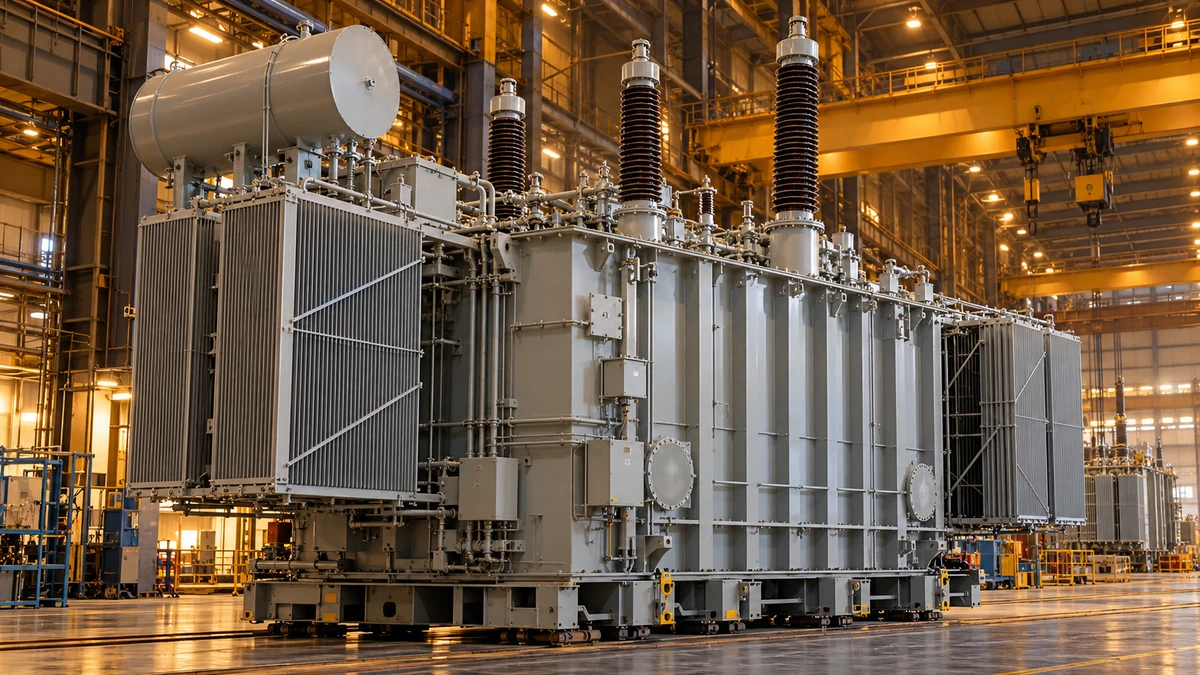
Siemens Energy raised its fiscal 2026 outlook on 23rd April 2026 as orders for power equipment increased. The group forecast comparable revenue growth of 14–16%, replacing an 11–13% range, and a profit margin before special items of 10–12%, against 9–11% previously. Its shares traded 6.6% higher at 16:40 GMT, an intraday movement following the announcement. Earlier that day, a record share price had made the group the third-most valuable listed company in Germany, behind Siemens and SAP, with a market value around €158 billion. Demand for gas turbines and grid components accompanied the expansion of energy-intensive data centres. US competitor GE Vernova had also raised its annual revenue and profit forecasts the previous day.
The financial position entering 2026
Siemens Energy finished fiscal 2025 with €58.9 billion in orders and €39.1 billion in revenue. Comparable growth was 19.4% for orders and 15.2% for revenue, excluding currency translation and portfolio effects. Its order backlog reached €138 billion at year-end. Profit before special items rose from €345 million to €2.355 billion. Reported profit, however, was €2.361 billion against €2.383 billion a year earlier: fiscal 2024 had included €2.038 billion in positive special items, largely associated with disposals. Net income increased from €1.335 billion to €1.685 billion, while free cash flow before tax rose from €1.859 billion to €4.663 billion. Gas Services led the improvement in cash generation. All four business areas contributed to comparable revenue growth. The November results also included a proposed dividend of €0.70 a share, subject to the shareholder process. Chief executive Christian Bruch linked the proposed return to dividends after four years to the company’s improved financial performance. Management also raised its medium-term growth and profitability targets through fiscal 2028.

Gas and grid orders in the first quarter
Siemens Energy’s first fiscal quarter of 2026 brought its backlog to €146 billion. Gas Services booked 102 gas turbines, its highest quarterly order count at that point. Customers converted 12 GW of existing reservation agreements into orders, while a further 12 GW entered new reservations. These were different commercial stages. The business’s profit margin before special items reached 16.6%. Grid Technologies increased orders by 21.8% against the preceding year’s first quarter and achieved a 17.6% margin before special items. Several data-centre-related orders in the United States amounted to a high three-digit-million-euro volume. Transformation of Industry also increased orders, particularly in compressors and electrification. Siemens Gamesa’s orders fell to €1.5 billion against an unusually large offshore order in the comparison period. Its operating result improved to a €46 million loss. Negative special effects of €175 million connected with the completed Indian wind-business sale brought its result after those effects to a €221 million loss.
The April preliminary results and revised forecasts
Siemens Energy’s preliminary second-quarter figures included orders of €17.749 billion, up 29.5% on a comparable basis, and revenue of €10.294 billion. Net income was €835 million, while free cash flow before tax reached €1.975 billion. The group raised its annual net income forecast to around €4 billion and its free cash flow before tax forecast to around €8 billion. Its revised business-area assumptions included:
- Grid Technologies: comparable revenue growth of 25–27% and a margin before special items of 18–20%.
- Gas Services: comparable revenue growth of 16–18% and a margin before special items of 14–16%.
- Siemens Gamesa: comparable revenue growth of 3–5%, with the margin before special items still expected to break even.
Siemens Gamesa’s quarterly loss before special items narrowed to €44 million from €249 million. The group scheduled the full second-quarter earnings release for 12th May; the April figures remained preliminary.
The $1 billion US manufacturing programme
Siemens Energy finalised its US investment programme on 3rd February 2026, following plans presented at its November 2025 Capital Market Day. The $1 billion programme covered existing-site expansions and one new factory, with more than 1,500 skilled jobs planned. A high-voltage switchgear facility in the Greater Richland area of Mississippi would include a training centre and employ up to 300 new workers. North Carolina projects covered transformers and resumed gas-turbine manufacturing in Charlotte, turbine parts in Winston-Salem, and engineering, sales and research in Raleigh. Those three communities were allocated 500 additional jobs. Other projects included blades and vanes in Tampa, research capabilities in Orlando, and copper and insulation components in Fort Payne, Alabama, where 120 jobs were planned. Painted Post, New York, and Houston, Texas, were included through compressor manufacturing and servicing upgrades. The programme also provided for apprenticeship expansion and workforce training.
Charlotte’s earlier transformer project
The US programme followed an earlier $150 million Charlotte transformer investment announced in 2024. Siemens Energy planned both new production and refurbishment capability at the site. The initial manufacturing target was 24 large power transformers annually, rising to 57 at full capacity. Repair and refurbishment capacity would start at 12 units a year and eventually reach 24. The company expected up to 559 direct operating jobs and 285 construction jobs in North Carolina. These figures described planned capacity and employment. The facility would extend Siemens Energy’s US presence into domestic manufacturing and service of large power transformers, alongside its existing operations in the state.

Two different investments in Nuremberg
Siemens Energy laid the foundation stone for a transformer-factory expansion in Nuremberg on 5th September 2025. The approximately €220 million project would add around 16,000 square metres, increase production capacity by about 50% and create 350 jobs. Construction was planned alongside continuing factory operations, with the additional production areas expected to become available by 2028. The site already employed nearly 1,000 people and had manufactured transformers since 1912. Bavaria offered up to €20 million in technology funding for the expansion. A separate €90 million investment announced in 2024 concerned converter production at the same location. The two projects served different parts of the equipment portfolio. Siemens Energy’s transformers from Nuremberg supported offshore-wind connections, grid stability and electricity links between countries. Across Germany, the group had invested around €1 billion over the preceding three years. It created approximately 1,300 jobs in 2024 and expected up to 1,500 more by the end of 2026.
Expanding the wider grid-manufacturing network
Siemens Energy’s grid-capacity programme extended beyond individual German and US factories. Its July 2024 network plans included converter electronics in Nuremberg and vacuum interrupters in Berlin, alongside manufacturing expansions in Austria, Croatia, Italy and India. The Kalwa transformer factory in India was scheduled to double its capacity. An associated engineering hub would support international projects through design, commissioning and project-management teams, with financial, legal and human-resources specialists also involved. Agustin Tenorio Bilbao, who led the Grid Technologies growth programme, identified both factory recruitment and these professional roles as requirements for expansion. He described a market shaped by decentralised renewable generation, the need to move electricity between regions, and replacement of ageing equipment. In Germany, the separation between northern wind resources and southern industrial demand was one example of the requirement for additional transmission. Tenorio Bilbao also identified renewable generation’s variability as a source of greater grid complexity. These were the company’s explanations for the manufacturing and staffing programme.

The North Sea contract pipeline
A framework agreement signed on 20th April 2023 covered three North Sea grid connections for TenneT. Siemens Energy and Spain’s Dragados Offshore formed the consortium, whose contract value was close to €7 billion. That figure applied to the consortium’s work. The BalWin3, LanWin2 and LanWin4 connections each had a planned transmission capacity of 2 GW, providing 6 GW collectively. Siemens Energy would manufacture major electrical equipment, including switchgear, transformers and converter technologies, at European factories. Dragados Offshore would construct and install the offshore platforms. At the time, Siemens Energy was handling 11 HVDC offshore-grid projects worldwide, spanning Germany, the UK and the US, and had completed five projects in the German North Sea. The ongoing projects were expected to feed more than 19 GW into high-voltage grids once commissioned. Offshore converters would receive alternating current from wind turbines and convert it into direct current for transmission by cable. Separate onshore stations would convert the electricity back into alternating current for the high-voltage network.
Building offshore converter platforms
By November 2025, Siemens Energy teams at Stord, Norway, were installing electrical equipment inside an offshore HVDC platform. The approximately 30-metre-high structures housed converter technology needed to connect wind generation far from shore. One transformer for the platform measured nine metres and weighed 323 tonnes. Installation included thousands of IGBT-based power modules across two converter rooms. Site project manager Dennis Sobotta led up to 20 specialists, coordinating their work with other installation activities and weather-dependent lifting operations. Siemens Energy’s offshore systems had grown from the 576 MW HelWin1 connection, commissioned in 2015, through a 900 MW standard to bipolar systems capable of transmitting up to 2 GW per platform. Christian Alexe, the group’s grid-access sales head, identified increased voltage, modularity and equipment integration among the changes supporting larger connections. He also identified lengthy approvals and shortages of skilled workers as project constraints. The Stord platform’s departure was still ahead when the November account was published; it was not a completed offshore installation at that date.

Xcel Energy’s ten-turbine order
Xcel Energy purchased ten large gas turbines and associated generation equipment from Siemens Energy in an order announced on 1st October 2025. The equipment supported two planned power plants with 2,088 MW of dispatchable capacity. At Tolk Station in Muleshoe, Texas, Xcel planned to retire its coal plant and install five SGT6-5000F turbines and five SGen6-1000A generators, providing 928 MW. A separate peaking plant in Gaines County would use five additional F-class turbines and five generators for 1,160 MW. The company planned the new facilities within a wider regional portfolio of 17 power initiatives and more than 5,000 MW of additional capacity by 2030. First turbine deliveries were scheduled for early 2026, with commercial-operation timing linked to Southwest Power Pool planning-reserve requirements. Siemens Energy designed the SGT6-5000F for rapid starts and load changes. The announced order and delivery schedule did not establish that either new plant had entered commercial service.
Long-term equipment and service work in Saudi Arabia
Siemens Energy announced approximately $1.5 billion in equipment and maintenance work for two Saudi Arabian power plants on 24th June 2024. Taiba 2 and Qassim 2 were planned in the kingdom’s western and central regions. Each would use HL-class gas turbines, steam turbines and generators to produce approximately 2,000 MW, giving the two sites nearly 4 GW collectively. China Energy International Group was Siemens Energy’s engineering, procurement and construction partner. The order included 25 years of maintenance services, with the group’s Dammam service hub supporting local capabilities. The plants were intended to supply a growing population and economy while replacing parts of an older generation fleet that included oil-fired equipment. The original schedule called for grid connection in simple-cycle mode in 2026 and permanent combined-cycle operation a year later. Siemens Energy estimated emissions savings of up to 60% against oil-fuelled plants. That comparison was a company projection for the new equipment, alongside plans for compatibility with future carbon-capture infrastructure, rather than evidence of carbon-neutral operation.

The wind business’s operational recovery programme
Siemens Gamesa’s late-2025 operating update set out changes in products, factories and servicing. The business reduced its wind-turbine portfolio from eleven platforms to four and resumed onshore market activity with SG 5.0 and SG 7.0 sales in Germany and Spain. Siemens Energy reported that its onshore operations had stabilised and quality issues had been addressed during fiscal 2025. Offshore nacelle production at Cuxhaven increased from 100 units in 2023 to 300 in 2025, with further increases planned for 2026. Management also planned annual offshore installations of 500 turbines in the following years. Service developments included a three-percentage-point availability improvement and 30% year-on-year aftermarket growth. Siemens Gamesa’s installed base was 150 GW. Its financial objectives remained conditional on the recovery programme: break-even in fiscal 2026 and a 3–5% margin by fiscal 2028, supported by offshore profitability, onshore improvement and additional service business. The company identified profitability and contract selectivity as priorities.
Vacuum-interrupter production in Berlin
Siemens Energy’s 2024 Berlin factory programme provided for approximately €60 million in investment through 2031. A converted 6,200-square-metre manufacturing hall supported expansion of vacuum-interrupter production for its Blue high-voltage switchgear portfolio. The company planned capacity of up to 30,000 interrupters within the following decade and a workforce exceeding 100 people. The facility used automation and digitally connected production, with electricity supplied from renewable sources. Vacuum switching and clean-air insulation were the technical basis of the equipment programme. The interrupters were intended both for incorporation into completed switchgear and for shipment as components to factories in China and the Americas. The programme therefore covered component manufacturing as well as finished-equipment supply. Siemens Energy identified investment in interrupters as part of its plan to expand high-voltage products using alternatives to fluorinated insulating gases. The stated capital expenditure and future output capacity were programme targets, while the converted production space formed part of its existing Berlin industrial footprint.

Electrolyzer manufacturing within the industrial portfolio
Siemens Energy and Air Liquide’s Berlin electrolyzer venture supplied another manufacturing capability in the group’s industrial portfolio. Its November 2023 production plans started with annual stack capacity of 1 GW. The approximately 2,000-square-metre facility combined robotics, coating equipment, assembly and camera-based quality control. Machines applied platinum and iridium coatings to opposite sides of sensitive proton-exchange membranes. The membranes were then laminated, pressed into forms, framed and assembled into stacks before performance testing in another hall. Other manufacturing locations, including Muelheim, assembled stacks into complete electrolyzer systems with the associated process equipment. Serialization and optical scanning supported production records extending to the iridium batch used in manufacture. Mara Mertens, the plant’s technical-services head, described the resulting digital production record as a basis for quality control and further process development. The joint venture paired Siemens Energy’s equipment-manufacturing capabilities with Air Liquide’s industrial-gas experience. Its scale-up plans concerned manufacturing capacity; they were separate from the amount of hydrogen a customer would actually produce with installed equipment.




















Leave a comment