
VusionGroup and Walmart: share warrants, connected shelves and the rollout behind the figures
VusionGroup’s Walmart partnership connects store installations, software and share warrants. Dated milestones explain the rollout, financing and contract accounting.

A share transaction alongside a store rollout
Walmart’s sale of VusionGroup shares brought the financing side of a retail-technology partnership into view on 1 July 2025. The retailer had sold 650,000 shares at €253 each, an 8% discount to the previous day’s closing price. VusionGroup traded 6.8% lower in the Reuters market snapshot. Walmart retained approximately 1.1 million share-subscription warrants, exercisable at €112 and representing a potential stake of about 6.5%. Full use of those rights depended on spending with Vusion reaching $3 billion. ODDO BHF analyst Aurélien Sivignon considered that threshold likely at the prevailing installation pace and expected further exercises in 2026 and 2027. His expectation concerned future transactions. VusionGroup’s shares had risen around 83% between the April 2023 Walmart agreement and the close on 30 June 2025.
New shares and an issuer cash receipt
The shares sold on 30 June came from Walmart’s exercise of 650,000 warrants subscribed in June 2023. The exercise added €72.8 million to VusionGroup’s cash position. Walmart’s subsequent placement sold the newly issued shares to market investors. After the transaction, VusionGroup’s share capital comprised 16,721,708 ordinary shares, and its free float increased by two percentage points. Walmart retained exactly 1,111,200 warrants, with the potential 6.5% holding calculated on a diluted basis and subject to conditions. At the time, more than 1,000 Walmart stores already operated the supplier’s technology. Walmart’s transformation and innovation executive Greg Cathey identified the commercial relationship as continuing alongside management of its warrant position. Chairman and chief executive Thierry Gadou expected the US rollout to finish within the following two years.

The agreement’s original store footprint
The rollout agreement announced on 27 April 2023 initially covered several hundred Walmart stores in the United States. Its first phase envisaged 500 locations over twelve to eighteen months and a total of 60 million digital shelf labels, with an opportunity to extend deployment elsewhere in the chain. The agreement followed a strategic partnership established a year earlier. SES-imagotag, as the supplier was then named, had developed the platform through a research programme lasting more than a decade, with initial patents filed in 2013. The design joined smart rails carrying communications and energy with digital displays that did not require their own batteries. Its transmission protocol used a low-power Bluetooth standard developed with Qualcomm and the Bluetooth Special Interest Group. Walmart vice-president Bala Prasanna connected the trials to reducing the time associates spent replacing paper price tags.
A broader supplier identity in 2024
SESimagotag remained the supplier’s principal electronic-shelf-label division after the group announced its VusionGroup name on 10 January 2024. Shareholders had approved the change at their 23 June 2023 meeting. The other business families covered cloud management, computer vision, analytics, retail media and industrial applications. VusionCloud supplied the retail IoT cloud platform; Captana covered computer vision and artificial intelligence; Memory provided analytics; Engage addressed advertising inside stores; and PDidigital served logistics and industry. Thierry Gadou described the renamed group as expanding from electronic labels into related digital-store markets. That portfolio placed labels alongside tools for observing shelves, handling data and supporting operations. The group planned to present the range at the National Retail Federation show in New York on 14–15 January 2024.

Rails, location data and connected shelves
EdgeSense’s January 2024 introduction brought the rail, display and software elements together in a digital shelf system. VusionOX and VusionCloud handled communications and services around the hardware. The company described centralised communications, three-dimensional product location and interactions between compatible devices as capabilities of the system. Intended uses included navigation inside stores, guided replenishment and order fulfilment, geofenced interactions and consolidation of IoT data within one platform. A shared energy source powered a rail carrying multiple displays, supporting additional sensing functions. Light-harvesting cells were another option in the design. VusionGroup presented lower energy use and a reduced carbon footprint as advantages over established electronic-label arrangements; those comparisons were supplier claims. The technical proposition joined pricing displays with the location and communication infrastructure required for wider store workflows.
Light harvesting for the shelf network
Exeger’s June 2024 collaboration with VusionGroup addressed the power supplied to the digital shelf system. The companies combined EdgeSense with Exeger’s Powerfoyle light-harvesting technology. Individual displays drew power from a shared battery rail, while the light-harvesting component replenished energy in the system. Exeger identified rechargeable batteries, a smaller rail battery and a larger power budget per shelf as features of the arrangement. The proposed design supported additional sensing and communication functions around the shelf. It used the Bluetooth Low Energy-based VusionOX protocol and proximity sensing alongside the power infrastructure. Exeger presented reduced maintenance and lower ownership costs as intended benefits. Its accompanying white paper and webinar set out the partners’ case for using indoor light to support more connected-store functions. The component announcement concerned a platform option; the partners’ stated savings and sustainability benefits remained their product claims.
A common wireless standard
The wireless collaboration preceded the Walmart rollout announcement. On 8 February 2023, Qualcomm Technologies and SES-imagotag announced work on electronic shelf labels using the Bluetooth Special Interest Group’s new ESL standard. The two companies had led the relevant working group, seeking an interoperable alternative to proprietary wireless protocols. Labels communicated in both directions with a central hub, carrying product and pricing information to shelf-edge e-paper displays. Qualcomm’s retail-IoT executive Art Miller connected the approach to Bluetooth’s qualification programme and installed device ecosystem. Roberto Di Pietro, responsible for business development at Qualcomm Europe, described the European collaboration, while SES-imagotag chief technology officer Andreas Rössl linked the standard to more connected shelves and stores. Their stated development objectives included scalable, low-power communications and secure operation. The wider VUSION platform also supported synchronisation of product information and marketing campaigns, order preparation and restocking, alongside price updates.
The April 2024 contract amendment
On 30 April 2024, VusionGroup announced an amendment accelerating Walmart’s US deployment of EdgeSense and VusionCloud. Alongside the installation schedule, the agreement extended software functions for merchandising, inventory management and preparation of online orders. The supplier expected roughly €1 billion of associated order intake to enter its figures in subsequent quarters. It also linked anticipated revenue growth to Walmart’s opportunity to start vesting warrants approved at the shareholder meeting on 2 June 2023. Philippe Bottine, then chief executive for the Americas and group deputy chief executive, identified EdgeSense, VusionCloud and the Bluetooth-based VusionOX operating system as the technologies supporting deployment. The amendment therefore changed both the pace of installation and the software functions covered by the customer agreement. Its announced order figure concerned bookings to be recorded in following periods.

What associates could do at the shelf
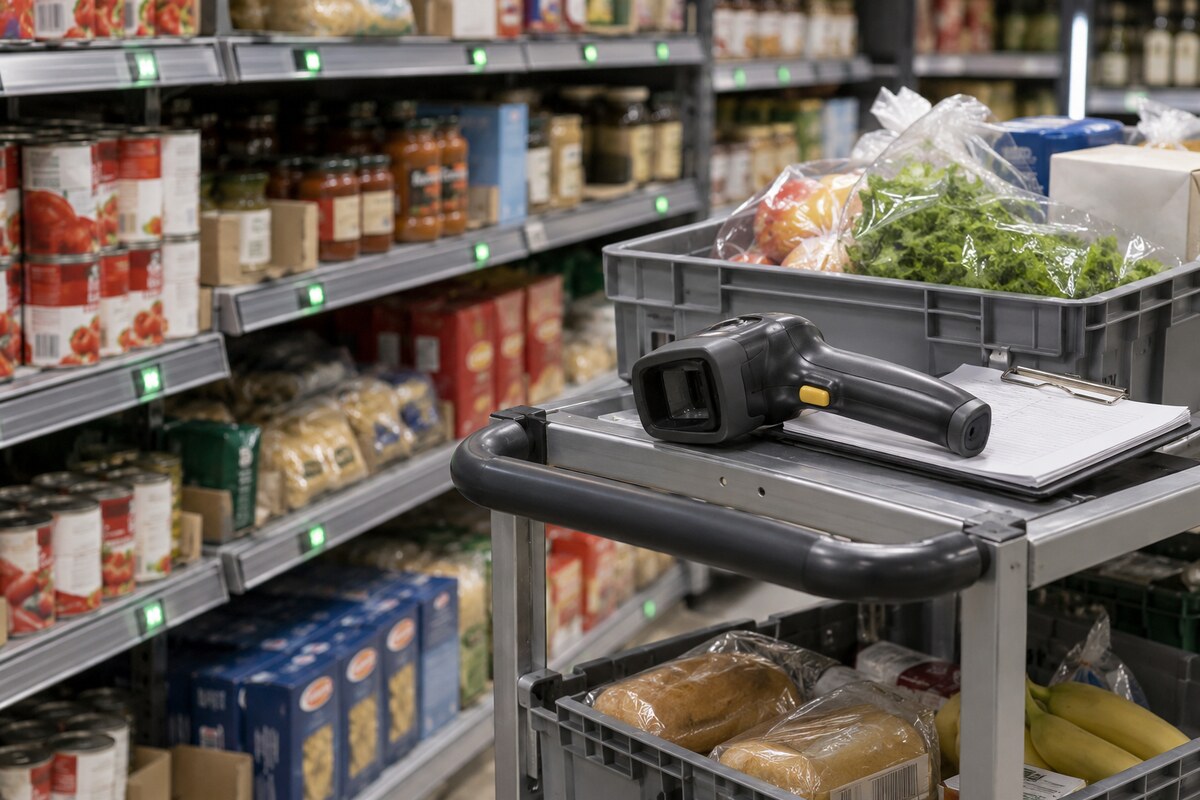
Walmart’s June 2024 account of testing at Store 266 in Grapevine, Texas, described how associates used the labels. Daniela Boscan, a food and consumables team lead, explained that a mobile application could update displayed prices without replacing paper tags individually. Walmart stores carried more than 120,000 products, with thousands of weekly pricing updates for new products, markdowns and Rollbacks. Boscan described a task that previously took two days being reduced to minutes in her experience. The account accompanied a plan to expand digital labels to 2,300 stores by 2026. It identified three practical workflows:
- Update shelf prices through the mobile application.
- Use Stock to Light to flash a shelf-tag LED during replenishment.
- Use Pick to Light to locate products for online orders.
The deployment scope expanded again on 23 December 2024. Walmart signed an extension covering another 2,300 stores, bringing the intended reach to its entire 4,600-store US fleet. Almost 500 stores had launched the programme by that announcement. The supplier expected approximately €1 billion of order intake from this extension to enter subsequent quarterly figures. EdgeSense and VusionCloud were the named solutions, with deployment directed toward replenishment, online picking and associate productivity. Greg Cathey welcomed the results of the installations already undertaken and supported extending them to further stores. Philippe Bottine described VusionGroup’s role as supporting Walmart’s store digitalisation programme. The December agreement had a new deployment scope and booking expectation, following the earlier April amendment.

Contract accounting and reported revenue
VusionGroup’s first-quarter statement, published on 23 April 2025, explains the accounting attached to that commercial agreement. Shareholders had approved 1,761,200 Walmart warrants in June 2023. Their initial €163 million fair value produced a contract asset and a financial liability. The asset was amortised against revenue over the estimated period required for Walmart to spend $3 billion with the group. That adjustment reduced IFRS revenue without changing invoiced sales or cash flow. The liability was revalued at reporting dates according to exercisable warrants and the share price. A second adjustment reflected agreed price reductions tied to future sales volumes: IFRS 15 averaged those prices over the contract’s life. First-quarter revenue was €215.2 million under IFRS and €232.8 million on the company’s adjusted basis. The €17.6 million difference reflected the Walmart contract adjustments. These were unaudited quarterly figures, and the company presented the adjusted measure alongside the IFRS figure to explain its operating performance.
Connecting shelf observations with commercial data
A NielsenIQ alliance added a data component to the supplier’s wider platform in May 2025. The partners announced the collaboration on 6 May; NielsenIQ’s page was published on 7 May. Their objective was to combine retail point-of-sale data, shelf observations and consumer datasets. Intended applications covered assortment, merchandising, promotions, pricing management and supply-chain efficiency for retailers and consumer-goods manufacturers. The initial markets were the United States, France and Italy, with further expansion planned in Europe, the Middle East, Africa and North America. NielsenIQ chief operating officer Tracey Massey presented the partnership as an extension of the company’s analytics capabilities. Thierry Gadou linked it to VusionGroup’s connected-label and retail-IoT technologies.

Later reporting: the first half of 2025
The sales update published on 30 July 2025 supplied a later view of the rollout’s contribution. Half-year revenue reached €612.9 million under IFRS and €648.0 million adjusted for the Walmart contract effects. Adjusted revenue from the Americas and Asia-Pacific was €451.7 million, up 134%; EMEA contributed €196.3 million, down 17.7%. VusionGroup attributed the stronger American activity principally to accelerated Walmart deployment. Group order entries reached €873 million for the half-year. Software, services and non-label solutions generated €90 million, including €35 million of recurring revenue. The cloud installed base exceeded 220 million labels across the group, compared with about 110 million a year earlier. Recurring services included cloud subscriptions, computer vision and analytics; non-recurring activity included installations, professional services and equipment. Half-year figures were unaudited.
Opening the platform to AI applications
A further product announcement followed on 20 October 2025, when VusionGroup opened its EdgeSense connected-store platform to AI applications and generative models. The company described APIs and developer partnerships intended to connect three-dimensional location data, computer vision and language models. Proposed applications included in-store guidance, smart glasses and assistants using the location of shelves and products as context. VusionGroup reported more than eighteen million connected rails across Europe, the Americas and Asia-Pacific. It envisaged the network supplying a continuously updated spatial map for applications developed around it. Roy Horgan, responsible for strategy, marketing and communications, and chief technology officer Andreas Rössl presented that direction as an extension of the platform’s physical-store infrastructure. Collaboration on pilot projects with retailers, research institutions, AI partners and device makers was to begin in the fourth quarter of 2025.

The 2025 financial year, reported in 2026
On 26 February 2026, Vusion announced annual results for 2025 with audit procedures still in progress. Revenue was €1,472.0 million under IFRS and €1,526.8 million on the adjusted basis. The adjusted total grew 51% from €1,010.5 million in 2024. Software, services and other non-label solutions contributed €211 million, including €83 million in recurring activity. Adjusted EBITDA reached €277.4 million, compared with €222.6 million under IFRS; the respective margins were 18.2% and 15.1%. The company generated €56 million of free cash flow and reported a €439 million net cash position. Thierry Gadou linked the strong final quarter to North American sales and the rapid installation of EdgeSense in Walmart supercentres. The annual presentation retained the distinction between IFRS and adjusted results, with the latter excluding specified non-cash Walmart-contract effects.
The relationship extends to Mexico
A rollout agreement for stores in Mexico was announced on 30 March 2026. Walmart de México y Centroamérica selected EdgeSense for its Walmart Express stores and planned a subsequent expansion across Supercentres. Completion of the Express rollout was targeted for the end of 2026. The initial deployment called for more than 1.7 million electronic labels and over 180,000 smart rails. Walmart Mexico also planned a pilot in its Bodega format to evaluate the technology in another part of its store estate. Chief operating officer Paul Lewellen connected the programme to modernising operations and helping associates serve customers. Philippe Bottine, by then Vusion deputy chief executive and executive vice-president for the Americas, identified the project as a further stage of the relationship.




















Leave a comment